Behind the Message: Todd's Upsell Pitch Forgot to Ask What Jenny Actually Wanted

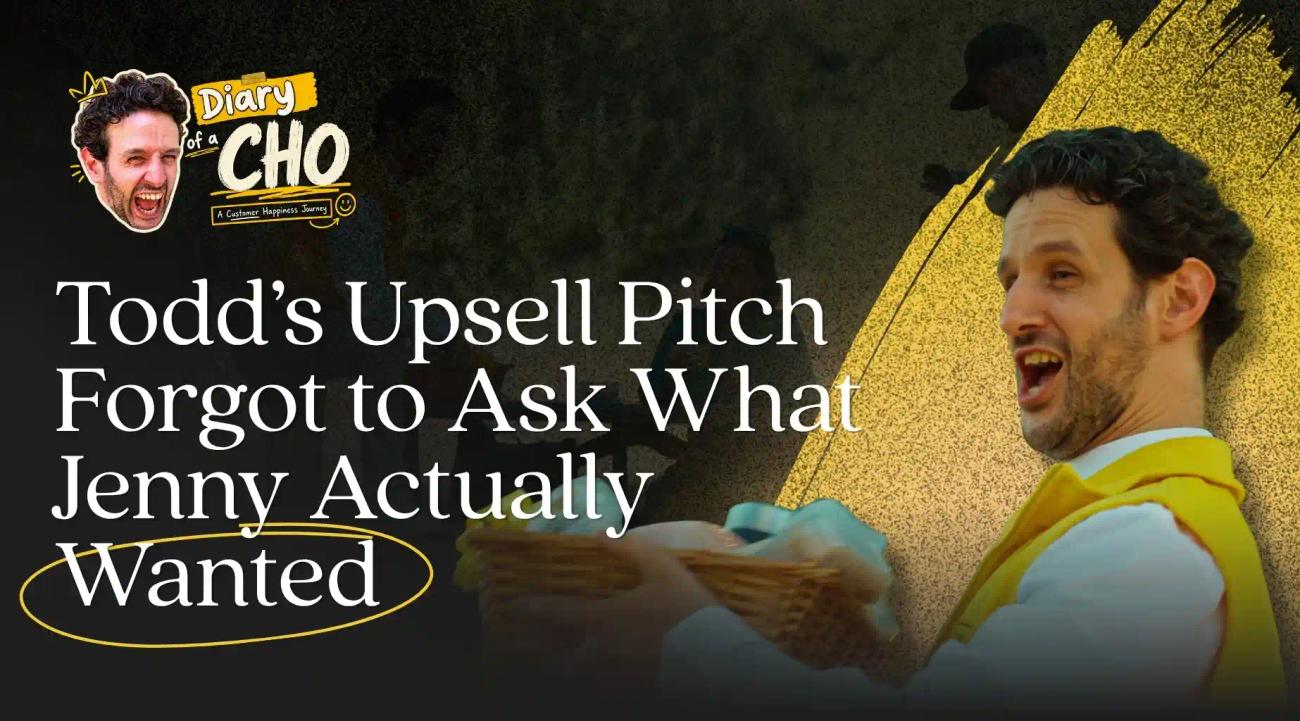
Kustomer recently introduced Todd Waffle, a Chief Happiness Officer with more enthusiasm than judgment, across a series of commercials, each one a joke with a real customer experience story hiding underneath it. This is the story behind the one where he tries to upsell a woman on her lunch break.
In it, Todd ambushes Jenny on a park bench, hamper in hand, to prove HAPLESS Co. can "upsell customers to the freaking moon." He slaps her sandwich out of her hand and offers her a kebab. Then chicken soup. Then a whole roast goose.
The absurd behavior
Todd had one job: turn this interaction into an opportunity. He came prepared: picnic, props, a whole bit. What he didn't come with was any idea of who Jenny actually is. He built an entire pitch around volume and enthusiasm, with zero information about the one thing that mattered: what she'd actually want.
The real CX problem
This is what generic upsell attempts look like when they're not built on real customer data. A picnic basket full of options feels like effort. But, it isn't personalization, it's just more stuff, thrown at a person in the hope that something lands. When it doesn't account for what the customer actually needs, more options isn't more helpful. It's more friction, dressed up as generosity.
Jenny's complaint, quoted verbatim by Todd, was that HAPLESS Co.'s service was bad at "turning customer interactions into opportunities." Todd heard that as a call to push harder. What it actually meant was: know something real about your customer before you try to sell them something.
Why conventional platforms create that problem
Most CX platforms treat upsell and conversion as a numbers game bolted onto the end of a conversation, a suggested offer, a generic cross-sell, a script that doesn't know it's talking to a vegan. The information that would make the pitch relevant (past purchases, stated preferences, what they've already told support) usually sits in a different system than the one handling the live conversation. So the offer goes out blind, and it lands the way Todd's did: technically an attempt, functionally useless.
What Kustomer does differently
Kustomer connects conversation history, purchase context, and customer preferences into the same place where the interaction is actually happening, so when there's an opportunity to convert or upsell, it's grounded in what that specific customer has already told you, not a generic offer thrown at the wall. The AI isn't guessing. It's working from real context, in real time, inside the conversation itself.
That's the difference between Todd's picnic and a relevant offer: one requires the customer to correct you after the fact, the other already knows.
The business outcome
LoadUp used Kustomer's AI to solve exactly the problem in Jenny's complaint, turning customer interactions into real opportunities. Their AI agent now handles 100% of inbound SMS sales inquiries as the first point of contact, and converts 33% of those inquiries into booked jobs end-to-end, without human intervention. CSAT rose roughly 5% alongside it, because the conversion wasn't a blind pitch, it was built on the details of what the customer actually needed.
That's what a real "opportunity" looks like: not a hamper of options hoping one sticks, but an offer that already fits.
The next step
Curious what AI-driven conversion looks like when it's actually grounded in customer context? [See how Kustomer turns conversations into revenue →]