How To Use AI to Reduce Average Handle Time


Average handle time (AHT) is one the most heavily scrutinized metric in customer support, and for good reason: every second shaved off an interaction scales into massive operational savings.
However, treating AHT purely as an "agent speed" metric creates a toxic dynamic. When agents are pressured to rush, they rely on robotic copy-paste templates, skip troubleshooting steps, and abruptly close chats. This artificially lowers AHT, but destroys customer satisfaction and drives up expensive repeat contacts.
The truth is, high AHT is rarely an agent efficiency problem—it is a tooling and information access problem. Agents spend minutes verifying emails, hunting for policies, and toggling between siloed systems.
To safely reduce handle time, you must use AI to eliminate the "dead air" and manual friction surrounding the conversation, rather than rushing the conversation itself. Here are seven proven strategies to lower AHT using modern AI.
1. Treat AHT as a Context Assembly Problem
If your agents have to check Shopify for order status, Salesforce for customer history, and a separate wiki for return policies, your AHT will always be high. Support leaders often push agents to type faster when the real holdup is context switching.
As one support manager pointed out on Reddit: "Agents spend significant portions of each ticket hunting for info across systems... The leverage point for AHT reduction is eliminating information hunting through agent assist tools that automatically compile relevant contexts when tickets open." By using AI to automatically assemble this context into a single, unified timeline before the agent even reads the first message, you can easily shave 2 to 4 minutes off complex tickets.
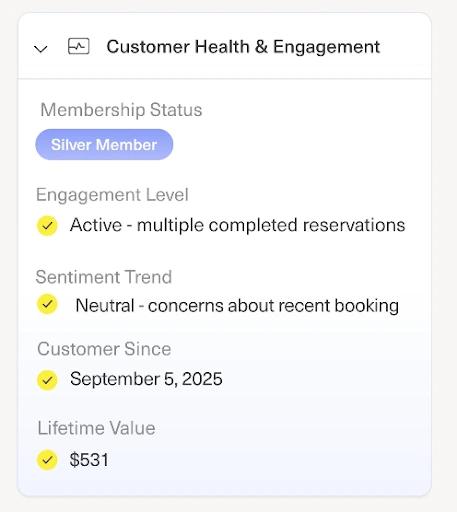
Pro tip: Use Kustomer’s unified data platform to bring all third-party system data (like billing and logistics) directly into the agent’s view. When an agent opens a ticket, Kustomer immediately displays the customer's lifetime value, recent orders, and past interactions, eliminating the detective work that inflates handle times.
2. Pre-authenticate Users to Eliminate the Discovery Phase
The first 60 to 90 seconds of an interaction are often entirely wasted on basic identification. An agent has to ask for an email address, verify an account number, or confirm a billing zip code.
A support agent shared a painful example of this exact bottleneck: "They’d then spell things out in excruciating and painful detail: 'My email is jennifer... J as in Julie. E as in exit. Nn. No, 2 n’s...' That took forever. Changing that authentication look-up process shaved 2+ minutes off our AHT."
Deploy an AI agent at the front of your support funnel to handle this structured data collection. The bot can securely authenticate the user, gather their order number, and pass that verified data to the human agent, allowing them to jump straight into problem-solving.
3. Automate After-call Work (ACW) Completely
After-call work—the time an agent spends documenting the interaction after the customer disconnects—often accounts for 15% to 25% of total handle time. Agents have to write summaries, apply disposition codes, and schedule follow-ups manually.
AI can eliminate this completely. Modern AI copilots listen to voice calls or read chat transcripts in real time and instantly generate a formatted summary the moment the interaction ends. The AI auto-populates the required CRM fields and disposition tags, turning three minutes of typing into a 15-second review-and-approve process.
4. Replace Robotic Macros with Generative AI Snippets
When agents are under strict AHT pressure, they naturally gravitate toward massive, pre-written templates. While this is fast, it frustrates customers who feel they are talking to a wall.
As one user noted: "The trick isn't really about templates - it's about having your system understand what type of issue it is and suggesting the right info to include... We've seen handle times drop to around 3-4 minutes when agents have all the context pre-loaded… they're not copy-pasting."
Instead of static macros, use generative AI copilots. The AI reads the customer's specific question, references your knowledge base, and drafts a personalized reply that is 70% complete. The agent then spends 10 seconds customizing the remaining 30% for empathy and nuance, perfectly balancing speed with a human touch.
Pro tip: Equip your team with Kustomer Concierge. Instead of forcing agents to search a separate knowledge base, Concierge surfaces suggested, context-aware replies directly in the chat window, applying your brand's specific tone of voice automatically.
5. Deploy Intent-based Triage to Prevent Misroutes
If a ticket is routed to an agent who lacks the permissions or knowledge to solve it, they have to transfer it. Every transfer adds another full cycle of introductions and context-gathering, brutally inflating your AHT.
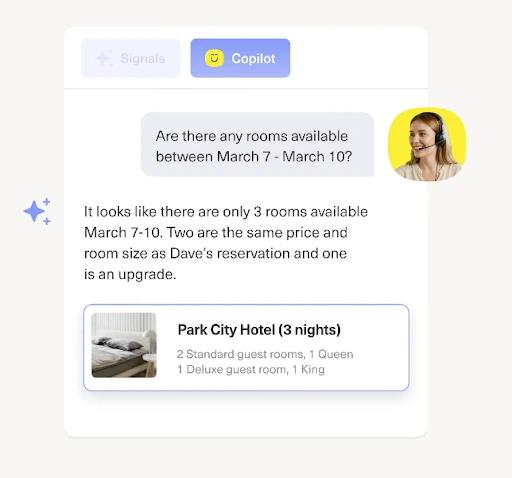
Instead of relying on customers to select the right category from a generic dropdown menu, use AI intent recognition. The AI analyzes the natural language of the customer's first message, identifies the underlying issue (e.g., "billing dispute" vs. "technical bug"), checks the customer's VIP status, and instantly routes the ticket to the exact specialist equipped to handle it on the first touch.
Recommended read → 12 Best AI Ticket Routing and Triage Tools for 2026
6. Identify and Automate Your Top Known-answer Drivers
Your AHT average is likely skewed by a high volume of incredibly simple, repetitive questions mixed in with complex technical issues.
Analyze your chat data to identify the top three known-answer issues—typically password resets, return policy questions, and order tracking. Instead of having human agents handle these, build autonomous AI workflows that allow customers to self-serve these specific customer issues.
Deflecting just 30% of these highly repetitive tickets drastically lowers your blended AHT and frees your humans to focus on high-value retention work.
✨ Product Feature Spotlight ✨
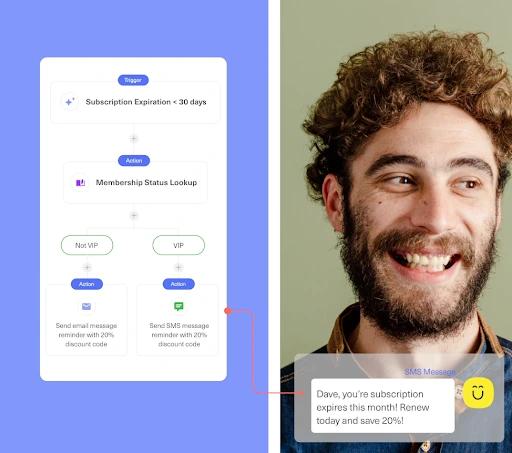
Use Kustomer Workflows to build time-saving automations that can cut your average handle time in half. By leveraging conditional branching and flexible REST API calls, you can instantly streamline repetitive tasks and orchestrate dynamic, multi-step resolutions across your entire support team.

7. Implement Metric Guardrails to Protect CSAT
AHT is a dangerous metric to optimize in isolation. If you strictly measure speed, agents will find ways to end interactions prematurely. To ensure your AI tools are actually driving efficiency and not just rushing customers, you must pair AHT with quality guardrails.
As one CX leader advised: "Shifted how we measure success. Instead of just AHT, we started tracking first contact resolution alongside it, which actually gave us cover to spend MORE time on complex issues if it meant the customer didn't have to loop back." Always measure AHT alongside First Contact Resolution (FCR) and seven-day recontact rates. If your AHT drops but your recontact rate spikes, your AI implementation is creating friction, not solving it.
Equip Your Team with the Ultimate AI for Support Teams
To safely reduce handle times without frustrating your customers, you must eliminate the busywork that slows your agents down. Relying on disconnected knowledge bases and forcing agents to toggle between five different browser tabs guarantees high AHT.
Kustomer is an AI-native customer service platform that unifies all of your data into a single, actionable timeline. By combining this deep context with powerful AI-driven tools, Kustomer removes the friction from every interaction.
- Unified customer data: Eliminate the discovery phase by instantly surfacing lifetime value, past conversations, and real-time Shopify data the moment a ticket opens.
- Contextual AI for reps: Arm your agents with an intelligent assistant that drafts personalized replies, translates languages in real time, and surfaces policy answers instantly.
- Automated ACW summaries: Reclaim lost wrap-up time with AI that instantly generates case summaries and applies disposition tags the second a conversation ends.
- Intelligent intent routing: Ensure the right agent gets the ticket the first time, drastically reducing transfers and redundant discovery questions.

Give your agents the AI-powered tools they need to resolve customer issues efficiently. Book a demo today to see how Kustomer AI can transform your contact service metrics.
FAQs
How does AI impact traditional call center metrics alongside digital channels?
In a true omnichannel environment, AI extends far beyond simple chatbots. By integrating with an intelligent IVR, you drastically improve call routing so every customer interaction reaches the right expert immediately. This reduces both your total hold time and average talk time, driving massive AHT improvements.
Furthermore, when you help agents with real-time AI assistance, they retrieve relevant knowledge instantly, requiring less time on the phone and completely eliminating the need for expensive callbacks.
Can automation help balance staffing during unpredictable spikes in call volume?
Absolutely. Pushing basic inquiries to self-service channels provides a faster resolution for the user and reduces the total number of calls entering the queue. This protects your service quality and helps control operational costs without requiring panic staffing additions.
For interactions that require human call handling, AI eliminates manual data entry by generating automated call summaries after escalation, significantly reducing overall hold time.
What is the most important KPI to track when deploying AI for support?
While tracking speed is important, prioritizing the overall customer experience ensures you do not sacrifice quality just to hit a number. Measure how effectively the AI identifies customer needs and prevents frustrating wait times. If your technology successfully lowers your average handle time without causing a spike in repeat contacts, you have successfully optimized your operations.