Behind the Message: Todd's Jog Isn't a Retention Strategy. It's a Symptom.

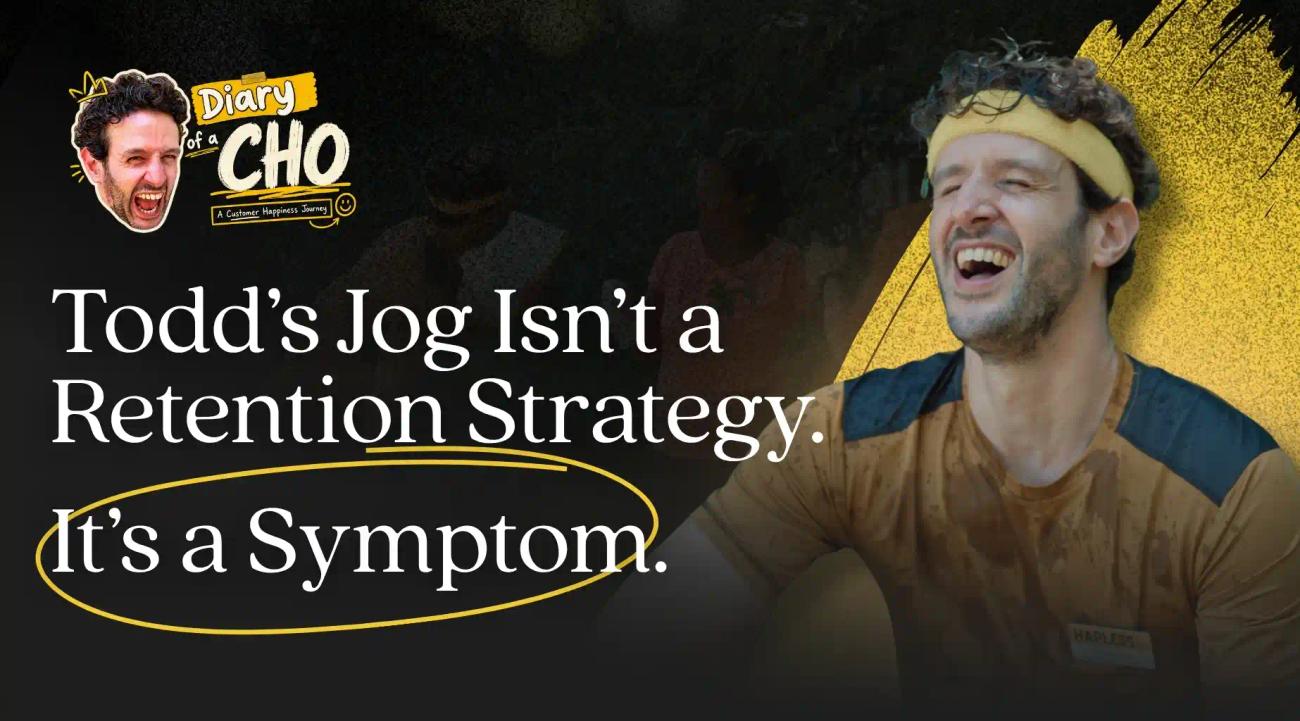
Kustomer recently introduced Todd Waffle, a Chief Happiness Officer with more enthusiasm than judgment, across a series of commercials, each one a joke with a real customer experience story hiding underneath it. This is the story behind the one where he tries to save an account mid-jog.
In it, Todd ambushes a customer named Jennifer mid-run to talk her out of not renewing. He's out of breath, out of his depth, and quite literally falling into a bush by the end of it. His parting shot, shouted while unconscious-adjacent: "I'll put something in your calendar."
It's the kind of retention save that only happens when a company finds out about the problem far too late.
The absurd behavior
Todd didn't choose to have this conversation on a jogging path. He was forced into it. Somewhere, someone flagged that Jennifer's company was "thinking about not renewing," and Todd's entire plan was to physically intercept her, no data, no plan, no actual offer, and win her back through sheer, sweaty proximity. He's not solving her problem. He's performing in front of a camera.
The real CX problem
Todd is a walking metaphor for reactive retention: the account is already at risk, the relationship is already strained, and the only move left is a scramble. A phone call nobody wants. A "let's jump on a call" email sent in a panic. Or, in Todd's case, a literal chase scene.
This isn't rare. Most CX and CS teams find out an account is at risk the same way Todd did, secondhand, late, and without the context to actually do anything useful about it. By the time someone says "we're thinking about not renewing," the warning signs were already sitting in the data for weeks. They just weren't connected to anything that could act on them.
Why conventional platforms create that problem
Retention risk rarely announces itself in one clean signal. It shows up as a support ticket volume creeping up, a sentiment score quietly dropping, a feature request that went unanswered, a usage pattern that's thinning out. Individually, none of that trips an alarm. But most CX stacks keep those signals in separate systems that don't talk to each other, support tickets in one tool, usage data in another, sentiment buried in transcripts nobody reviews until it's a crisis.
So the warning arrives the way it did for Todd: as an urgent, last-minute alert that something is already broken, with no time left to fix it properly. Reactive retention isn't a strategy. It's what happens when nobody was set up to be proactive in the first place.
What Kustomer does differently
Kustomer connects conversation history, sentiment, and customer context into one unified timeline, so risk signals don't sit scattered and silent until it's too late. Instead of finding out an account is unhappy from a single dramatic moment, teams see the pattern building: rising friction, declining engagement, an issue that never quite got resolved.
The contrast? Todd shows up once, out of breath, with nothing to offer but his own visible desperation. A team working from a unified customer view shows up earlier, with the actual context needed to address the real problem before the customer starts drafting the "we've decided not to renew" email.
The business outcome
Daily Harvest built its service organization around exactly this shift, from reactive to proactive. With a unified view of the customer built into their workflow, Daily Harvest turned its service team into a genuine revenue-driving function: agent productivity doubled, and the team drove a 10% increase in weekly revenue, not by chasing customers down after the fact, but by acting on signals earlier in the relationship.
That's the outcome a real retention strategy produces: no bushes, no chase scenes, no shouting into a calendar app. Just a team that already knew what was coming.
The next step
Curious what proactive retention actually looks like when the signals are connected? [See how Kustomer surfaces risk before it becomes a renewal conversation →]