Your AI Agent Can't Resolve What It Can't Reach


Most AI agents in customer service are good at exactly one thing: producing a plausible answer. Ask about the return window and you get the return window. Ask where your order is and you get a friendly paragraph explaining that orders typically ship in three to five business days.
But the customer doesn’t reach out to ask about a policy. They want to know about their specific order.
Still, plenty of AI deployments stop at answering with policy information.
Contained is not resolved
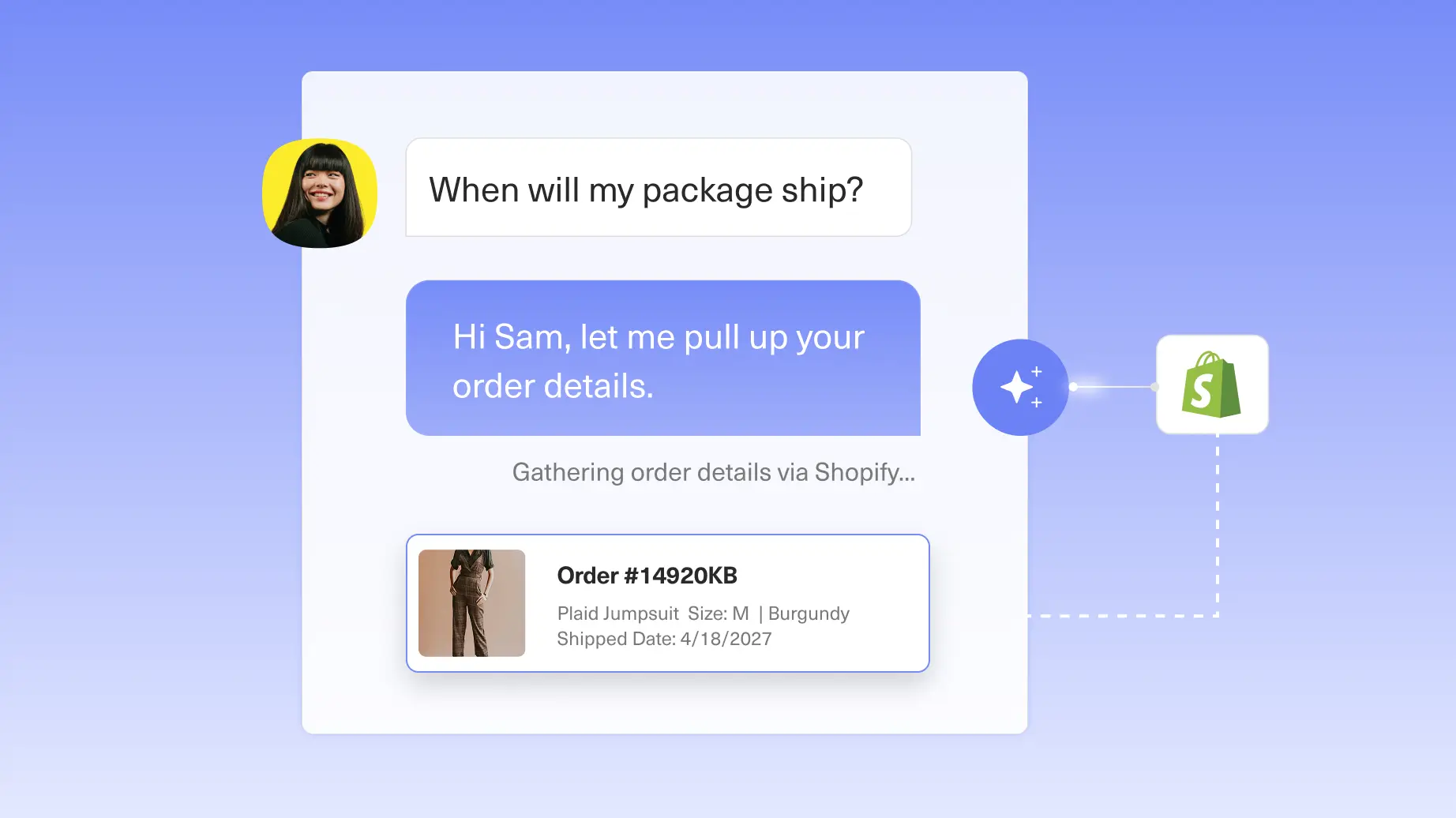
The reason is structural, not a prompting problem. A typical AI agent has two things available to it: a knowledge base and the text of the conversation in front of it. What it does not have is the order, the subscription status, the loan balance, the delivery exception, the account standing. Those live in Shopify, in a billing platform, in a homegrown backend somebody's engineering team built four years ago.
Without access to those systems, the AI can describe a process. It cannot complete one. So it either hands the conversation to a person or ends it with a customer who now has to go do the work themselves.
Teams hit this as a ceiling. The easy questions get handled, resolution rates flatten, and every remaining inquiry needs a fact the AI cannot see.
What resolution actually looks like
We pulled recent Concierge data across our production customer base to understand what separates conversations the AI closed completely from conversations it did not. End to end resolution is a strict bar here: the AI handled the entire conversation, no person ever sent a message, no escalation, conversation closed.
When we looked at the most recent 500,000 resolutions powered by Kustomer Concierge:
- 73% involved at least one call to an external system. The AI agent hit an HTTP endpoint the customer configured, or a tool exposed over MCP.
- Around 8 in 10 customers with meaningful resolution volume are calling an external API on the conversations their AI closes.
- 96% pulled information from outside the conversation, whether that was an API call, an external knowledge source lookup, or both.
- 67% did both in the same conversation. An external knowledge lookup to understand the policy, and an API call to act on this specific customer's situation.
The 67% matters most. Most resolved conversations use knowledge and integration together, in one exchange. The knowledge base tells the AI what the return policy is. The API tells it whether this order, purchased on this date, in this condition, actually qualifies.
How Kustomer connects to your systems
There are three paths to connecting Kustomer AI agents to external systems:
External knowledge source syncing. Teams can sync public content, such as individual URLs, full sitemaps, Guru, Notion, Confluence or Zendesk Help Centers, so the AI agent can seamlessly reference up-to-date documentation during customer interactions.
Custom API tools. Admins configure OpenAPI tools that the AI agent can call during a conversation. No engineering request, no separate middleware layer. You describe what the endpoint does and when it should be used, and the agent decides at runtime whether the conversation calls for it. Customers commonly build tools for order lookup, subscription changes, refund processing, membership status, appointment scheduling, and eligibility checks.
Remote MCP Server. Kustomer supports the Model Context Protocol, so the AI agent can consume tools from an MCP server the same way it uses a native one. If your team has already stood up an MCP server for internal tooling, the agent can use that surface directly instead of requiring you to rebuild it as bespoke endpoints. Adoption of this method is rapidly growing as more systems support it.
In any of these methods, the agent is not following a scripted decision tree. It reasons about the customer's actual question, picks the tool, calls it, reads the result, and continues the conversation with the answer in hand.
What customers are actually building
A BNPL fintech app runs the deepest deployment on our platform, with more than 70 configured tools. Its AI agent pulls loan details, generates multi-payment links, and verifies government-issued IDs mid-conversation. More than nine in ten of its resolved conversations involve at least one API call, at a volume no one else on our list approaches.
A connected fitness company built its deployment around subscriptions and billing. Refund requests, payment failures, and subscription issues all resolve through live calls into its systems. Roughly 97% of its automated resolutions touch an API.
A kids' subscription commerce brand handles order status, shipping confirmations, and subscription cancellations. Most teams route cancellations to a person by reflex. This one lets the AI process them, which takes a high-volume, low-judgment task off the queue entirely.
A furniture brand with a small support team shows this is not only for companies with platform engineers to spare. Around 30 tools covering product lookup and order retrieval, and a 61% end to end resolution rate.
An accessories brand went the opposite direction on complexity: five tools total, focused almost entirely on order status and edit eligibility. Nearly 85% of its resolutions are API-backed.
Compare those last two. Five tools and seventy tools are both defensible builds. What matters is whether the ones you built cover the questions your customers actually ask.
Where to start
Start with your inquiry mix rather than the integration catalog.
Pull your top five contact reasons by volume. For each one, ask a specific question: what fact does the AI need in order to finish this conversation without a person? Not what knowledge article it needs, what live fact about this customer. Order status. Subscription state. Whether the return window has closed. Whether the payment actually failed.
That list is your integration roadmap, and it is oftentimes short. In most support organizations a handful of inquiry types carry the bulk of the queue, so one or two well-scoped endpoints against your commerce or billing platform go a long way.
Then watch what happens to escalation reasons. When an inquiry type keeps escalating despite the AI having good knowledge coverage, that is almost always a missing fact, not a missing article.
The question to ask any AI vendor
Every platform in this category will tell you it integrates. Push past that and ask what the AI does with the connection once it exists.
Ask to see a conversation where the AI changed something in a system of record rather than describing it. Ask what happens when the API returns an unexpected result. Ask who configures a new tool, and how long it takes.
If you are already a Kustomer customer, your Customer Success Manager can help you map your top inquiry types to the systems that hold the answers. If you are evaluating AI for customer service, book a demo and bring your hardest inquiry type with you.