Behind the Message: Why Todd's "360 Profile" Is Everything Wrong With Customer Data

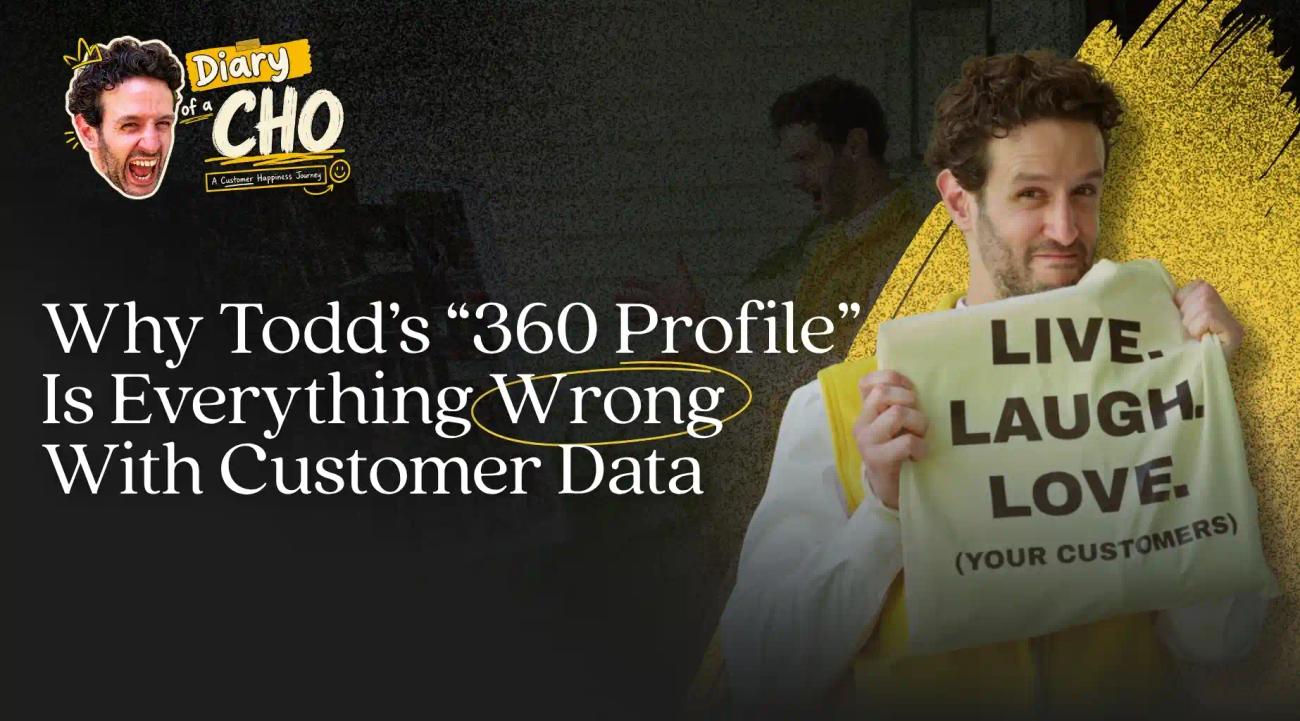
Kustomer recently introduced Todd Waffle, a Chief Happiness Officer with more enthusiasm than judgment, across a series of commercials, each one a joke with a real customer experience story hiding underneath it. This is the story behind the one where he builds a customer 360 profile the hard way.
In it, Todd surprises a customer with a giant vision-board collage of their own life. Built from six weeks of secret surveillance. Complete with their coffee order, their fear of swans, and a detail about their car that nobody asked for.
The customer's reaction wasn't delight. It was "get that out of here."
Which is, honestly, the point.
The absurd behavior
Todd thinks he's solved customer understanding. He has photos, habits, quirks… a wall of data points about one person, gathered obsessively over weeks. In his mind, more information equals more insight. So he shows up with the receipts, expecting gratitude.
What he gets is a door slammed in his face.
The real CX problem
Todd's mistake is one a lot of CX teams make without the stalking: they equate volume of customer data with understanding of the customer. More fields in the CRM. More integrations. More tabs open. More history logged. And yet when a customer actually reaches out, the person helping them still has to go dig through all of it, or worse, ask the customer to repeat themselves for the third time.
Collecting data isn't the hard part anymore. Every platform collects data. The hard part is making that data mean something in the moment it matters, when a real person is asking for help right now.
Why conventional platforms create that problem
Most CX stacks are built the way Todd built his vision board: assembled from scattered sources, bolted together after the fact, organized around collection rather than use. A support ticket here. A purchase history there. Marketing engagement somewhere else entirely, in a tool that doesn't talk to the other two.
The result is a "360 view" that only exists as a slide in a sales deck. In practice, agents are still toggling between tabs, piecing together context by hand, while the customer waits. The data technically exists. It just doesn't help anyone in the moment they need it.
That's surveillance, not service. Information without context is just a bigger pile to search through.
What Kustomer does differently
Kustomer is built around one data foundation, not a collection of bolted-on integrations that each hold a piece of the story. Every conversation, order, and interaction lives in a single, unified timeline for that customer, so the context an agent or an AI needs is already there, already connected, already usable. No digging. No separate systems to reconcile.
And because it's one foundation instead of scattered records, it doesn't just sit there getting bigger, it gets more useful every day you run it, because every interaction can add to the same connected picture instead of another disconnected pile.
That's the difference between Todd's approach and ours: he was looking backward at everything he could gather. We're built to act intelligently on what's relevant, right now, for both the humans and the AI handling the conversation.
The business outcome
When context lives in one place, resolution gets faster because nobody's hunting for history across five tools. Personalization gets more respectful, because it's used to solve the actual problem in front of you, not to prove how much you've been watching. And every one of those interactions makes the next one better, because it's all feeding the same timeline instead of scattering into separate silos.
Orvis lived the "before" version of this problem: a fragmented platform that split voice and digital channels, leaving agents without a unified view of the customer. After consolidating everything around one customer timeline, Orvis handled a 327% inbound surge with 100% uptime and SLAs intact, and did it with a leaner team, cross-training down from 100+ agents to 30 specialists.
That's what a real 360 view is: a system that turns data into faster, better outcomes for the person asking for help, even when volume spikes.
The next step
Curious what an actual unified customer timeline looks like, no vision boards, no stalking required? [See Kustomer's Customer 360 in action →]