Before It Breaks: How Elite Tech Support Teams Protect Customer Trust
Listen to the episode
Watch the Live Recording
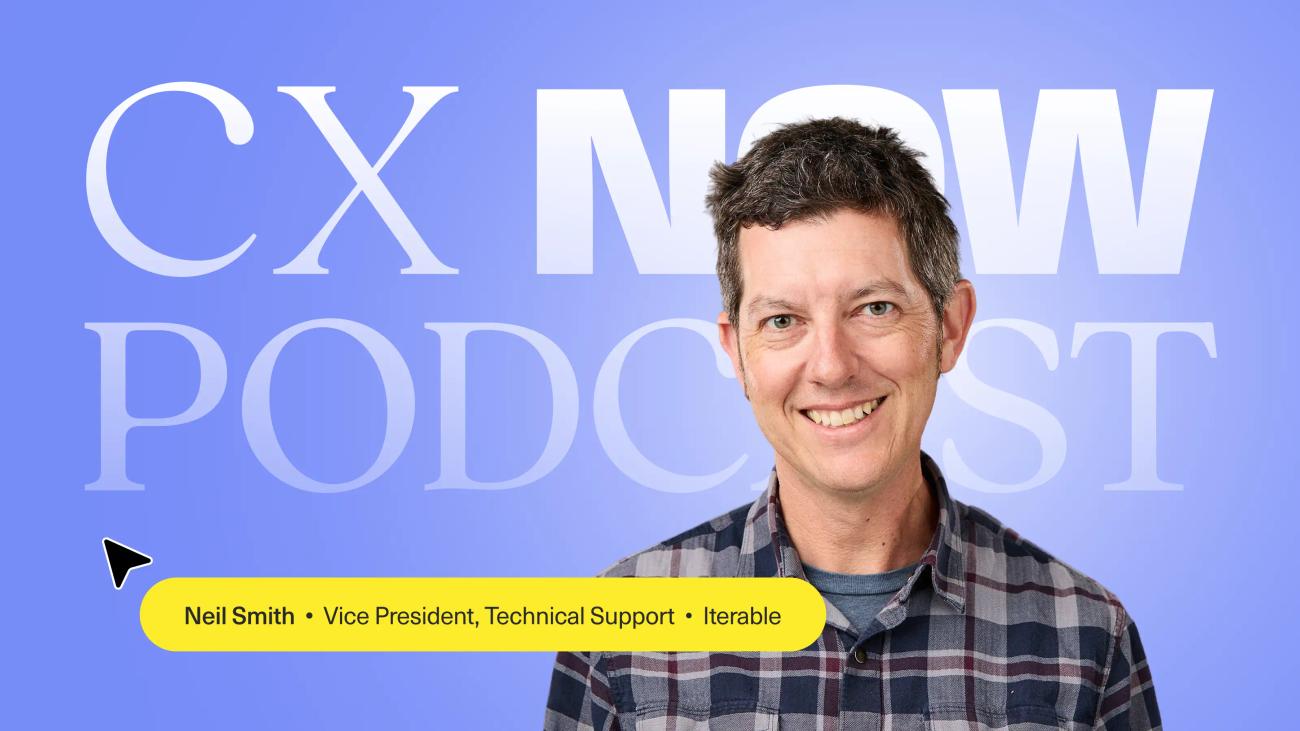
In this episode of CX Now, host Lisa Painter is joined by Neil Smith, VP of Technical Support at Iterable, a customer communications platform. An eight-year veteran of the company, Neil has grown Iterable's global support team from a three-person operation to a 56-person organization delivering 24/7 support across email, web, Slack, and live chat. Under his leadership, the team has built out a tiered support model — and in doing so, created what Neil describes as a business within the business.Join us for an extra-special longer episode as Lisa and Neil chatted in-person in Austin:
This interview has been lightly edited for clarity.
Lisa: We're here today to talk about how elite technical support teams are protecting customer trust. We know that's very important in the world of customer experience. So let's get right down to it. What does trust actually mean to you in practice? We all know our customers are important and we want them to trust us and we want to do the best by them.
Neil: In the world of software and SaaS, there are a number of layers of trust. Obviously, when a customer signs on the dotted line, the very foundational layer is: is this thing going to work for me when I go to use it? That's always been a key focus for Iterable. It's somewhat beyond the purview of technical support, but part of building trust is acknowledging that things do occasionally go wrong — things don't behave as they're supposed to, or AWS has an outage or something like that. Our role as the frontline with the customer is to be there when things don't behave as they're expecting.
A lot of the trust-building happens in those key moments. I've learned over time that oftentimes a customer will end up with more loyalty if something goes wrong and you fix it for them than if nothing went wrong in the first place. I try to instill in my team that sense that you have an opportunity to increase the strength of the customer relationship through these interactions.
So the foundational layer of trust is: make sure the platform works. And then the next layer on top of that is: when it doesn't, be there for them.
One of the things we're in the process of implementing at Iterable is something one of our managers came up with — a concept called PACE. It stands for Proactive, Articulate, Comprehension, and Execution. It allows us to evaluate team members across those four areas. We hear a lot these days about proactive support — and I think it's a bit of a buzzword — but when you're interacting with a customer, you do want to get ahead of their questions as much as possible and anticipate what they're going to need before they tell you. That means really diving into the questions they're giving you, looking for evidence that a follow-up question is coming, and answering it before it arrives.
Lisa: We want to solve ahead. We want to look at those signals. And what you're sharing leads into what I was wondering about next: what signals do you pay attention to that tell you customer trust might be breaking down, without them specifically calling it out? Are there things you and your team watch for?
Neil: One thing that's really interesting these days — and yes, we are going to get to AI — is that the advent of AI tools, particularly agent copilot-type tools within the support world, can help support team members identify those signals ahead of time.
Let's say a piece of code has been deployed in your platform and it's created a bug. A customer writes in and talks to one agent, who starts troubleshooting. Then another customer experiences the same issue and connects with a different agent, who starts troubleshooting from scratch. If you have AI tooling in place that can connect those dots in the background, that second agent will already be given the insight: "Hey, I think this might be related to this other ticket that was just raised." Leveraging these modern tools is one way we can start looking for those signals.
Lisa: That's key. And just think about how many more signals we have today compared to before AI. It's serving things up on a platter in a way we didn't have before.
Neil: And also from more of a management layer, we've started using a voice-of-the-customer tool that effectively scans all of our touchpoints — whether they're support tickets, Gong calls, or Momentum calls — aggregates all of that data, and provides insights about which customers might be most at risk or trending from positive sentiment toward negative. That's exactly what I've always felt AI should do — the things we as humans struggle with, like working through massive data sets and finding the gold within them. And we're starting to see that.
Lisa: I've been in this industry for thirty years and we always talk about being more proactive rather than reactive. You mentioned it's a bit of a buzzword, and it's something we're all striving for. As consumers, we've probably all experienced proactive support and been blown away by it. But honestly, it's not what we see across the board. What are your thoughts on proactive versus reactive, and how they commingle in this world?
Neil: I never want to stray too far from the fact that part of the job of support is to react to customers — to be there for them when they need you. But as leaders within support, one of the things we can do is look for the common things that come up and get ahead of them.
I'll give you an example. Within our platform, we have this concept of field mapping — basically the number of fields you can capture for your users. There's a limit, and if you reach it, you can't create any new fields. What we've done is put in place an alert that will automatically, using webhooks, create a ticket that says: "This customer is approaching their field limit." That ticket gets assigned to one of our agents, who is then responsible for reaching out to the customer to say, "Hey, you're getting close to your field limits." And when a customer gets there, something usually isn't configured correctly on their side. So we help them figure out what that is and fix it before they hit the limit. It's all done by wiring up a few systems — otherwise the customer would have had no idea until something they expected to be created wasn't, and then it becomes a reactive ticket.
Lisa: Yeah, no thanks. Let's talk about insights. You can't lead an organization and manage what you can't measure. It's hard to be proactive without them. So with customers who have increasingly complex environments, how are you making sure your team members not only have insights into the technical environment but also understand customers' business outcomes — what they're actually trying to achieve?
Neil: We address it in slightly different ways depending on the customer's support tier. We have our Premier tier of support, where customers are assigned a designated support specialist and either a Slack or Microsoft Teams channel to communicate with that person. All of our support tiers are paid — we have Standard, Plus, and Premier. For Premier, you get that designated support specialist. It's kind of like having an Iterable expert sitting next to you all day, just waiting for you to need their services. Over time, because these specialists have a defined book of business, they have the bandwidth to really get to know their customers — understand their use cases, understand what campaigns are coming up. If it's a B2C customer planning a big Super Bowl campaign in February, their specialist can get ahead of that, alert our engineering team that there's going to be significantly more load than normal. It's easier for those folks to develop true insights because they have a smaller book of business.
For customers on our Standard or Plus tiers, it's more of a pooled environment — in theory, any support agent could end up working a ticket for any customer. It's a lot harder to really know those customers, unless they're frequent flyers we hear from a lot.
In the past, within Zendesk and other support platforms, there are ways to surface customer information — like from Salesforce — and just having access to that, seeing what industry they're in, the size of the company, where they're located — those little tidbits are helpful while the specialist is having that support interaction.
These days, with our AI agent copilot, we can get a lot more insight into what a customer is like. One of the first things an agent can do when a ticket arrives is open up the copilot and say, "Tell me about this customer" — before they've even responded. Give me some insight into who this is, what their concerns are likely to be, what kind of marketing campaigns they're sending. Has there been anything significant recently? Having that copilot there lets the agent understand the customer much faster than in the past.
Lisa: And it's meaningful to the customer. We're all customers — that's one thing I love about this industry. You can relate because you experience it yourself. You love it when the person serving you shows genuine interest, leans in, maybe even knows you. I think everything we've talked about today also builds to the confidence of your team. Let's talk about that. We don't get into CX unless we enjoy helping others — it's in our DNA. And I think a lot of what keeps people here long-term is confidence. What are you doing with your team to make sure they feel confident when they're working through really high-pressure situations?
Neil: I love seeing good service in action. Last night — I was telling you earlier — I went out here in Austin to a restaurant bar to watch the basketball. I'm not a basketball fan, but there was a big game and the local team is the Spurs, so a lot of people wanted to see it. The place I went to was not staffed appropriately. They had tons and tons of TVs, tons of people, and one poor bartender. I felt so bad for this young woman. She kept her cool the entire time — moving up and down the bar, continuing to smile. You could tell it was a pressure situation. There were servers too, so she was also providing drinks to them. I just love seeing really good service in action.
One of the things we've done at Iterable Support is this concept of STARs — Skills Acquired Through Alternate Routes. A number of folks we've hired over the years have not come from support backgrounds. They've come from backgrounds with direct customer-facing experience and then augmented that by learning technology. A classic profile is someone who worked in food service and then completed a software boot camp. We've had three or four people with that exact profile go on to be very successful — working through the support program and then moving into roles like Solutions Architect or Solutions Consultant, or sometimes growing their careers and leaving the company, which is fine.
Merging strong customer experience skills with technical skills makes a really good support agent. In some ways, you don't need to do an awful lot to build that confidence because you've hired people who are naturally comfortable in high-pressure customer situations.
Our platform is easy to use but has significant depth. There are a lot of things our team needs to understand — minutiae, edge cases. We've worked hard to make sure our enablement materials are strong. When you start at Iterable, you go through our customer-facing academy — pretty much exactly what a customer would learn when they start using the platform. Then through our overall Customer Success materials, since support lives within customer success at Iterable. Then you go into our support-specific materials, which is when you get into things like how to query logs for specific campaigns, templates, customer journeys — the more technical stuff.
We use a platform called WorkRamp, which is an online learning platform, and we've built out a set of WorkRamp courses that all of our team go through. The goal is that about six to eight weeks into the role, they've completed all of those materials and are ready to go.
The other thing we do — and I think this is something anyone can leverage — is provide a tech buddy to all of our new hires.
Lisa: Everybody wants a tech buddy.
Neil: It has multiple benefits. For the new hire, at the end of every day they'll spend half an hour with their tech buddy. They save up their questions throughout the day rather than pinging this person constantly, and then they knock them all out at once and they're ready for the next day. It's also good for the tech buddy, because sometimes the best way to learn is by teaching. And it builds confidence in the tech buddy as well.
Lisa: I'm not surprised you spent more time talking about team confidence than the other parts — you're such a people person. I could tell from the moment I met you that you truly care. And your example from the restaurant last night — those hospitality folks working under constant pressure, that skill is so transferable to the tech world.
All right, let's talk about the new era we're in. What are customers asking you to do now that they weren't asking a few years ago?
Neil: One thing we're finding is that customers have higher expectations around the delivery of features. It's not necessarily that they're asking support to do something different — they're asking the business to do something. With the advent of AI-driven coding tools like Cursor and the like, the expectations on engineering teams are ramping up significantly.
A few weeks ago we saw Claude Code introduce consumption-based pricing, and I suspect we're going to start seeing engineering leaders and CFOs become much more careful about how much engineers are using these tools. The incredible velocity of feature development we're seeing right now will slow because of the economics. These tools are going to be used more judiciously. The barrage of new features across all of these platforms will slow down — with that said, the velocity will still be higher than it was in the past.
Our customers, who are often software platforms themselves, understand this. When they're asking for something, they expect it now. I've seen it at industry conferences — it used to be that there'd be one headline product release and everything was about that.
Lisa: It was all about that one thing.
Neil: Exactly. Now you go to these conferences and there's the headline product release, and then there's "but wait, there's more" — this and that. You walk out of the keynote and your head is spinning. How am I going to use this new feature? Is it relevant to me? I sometimes wonder if that's the right approach. As a consumer of these platforms, it can be difficult to process.
Lisa: We hear that a lot in our community — there's a lot to digest. Let's talk about AI. It's come up throughout our conversation. But where do you feel like it's truly, genuinely helping your team? Maybe share one or two anecdotes where you feel this is actually moving the needle.
Neil: There are three use cases for us. The first we've had in place for almost three years — we use an LLM-powered chatbot for customer-facing interactions for customers on our Standard and Plus tiers. It opened up a new channel for them. Previously, they didn't have access to a chat-type environment. Initially, the vendor we used had a proprietary algorithm and we were finding about 35% of those conversations ended with the customer satisfied — which is not great. Anyone who's interacted with a chatbot in the last ten years would probably say, "Yeah, maybe three out of ten times it was helpful." These days, as chatbots have moved from proprietary algorithms to LLMs, resolution rates have scaled dramatically. As soon as we switched, it went up to about 70% — and I mean proper resolution, not just deflection, which has become a bit of a dirty word in support, but actual resolution where the customer was clearly satisfied. That's a really high number, and the ROI on that tool has been great.
Fairly quickly after that, we deployed an agent copilot. We used Zendesk's own agent copilot — and it was a total failure. Our agents weren't using it, it wasn't helpful for them. There was the "I know better than AI" syndrome. The data sources available to it were very limited. We invested in it for two years and it just didn't work well for us.
When the time came to switch to a different agent copilot, we did immediately. And unsurprisingly, in those two years the technology had advanced dramatically. We're now able to leverage a larger number of data sources — our internal knowledge base, specific Slack channels, and so on. With the previous copilot, we had about 10–15% adoption. The new one has 85% adoption. And we ask all of our team to use the thumbs-up/thumbs-down function on the answers provided. The satisfaction rate is something like 98%.
The most recent one is a voice-of-the-customer platform that pulls in all of our ticket information and our Gong calls — calls that our CSMs and account executives have with prospects. It looks at all of that data and provides insights on overall sentiment, risk, and satisfaction on an account-by-account basis. We get automated weekly reports on, say, our 10 to 15 biggest customers — here's the health of each one, here are the ones you need to focus on, here are the ones that have shifted from unhappy to happy or vice versa. It does product-level analytics and insights as well. So we can now start to transition from just firefighting — which is what support has traditionally been —
Lisa: That's all we've done our whole lives.
Neil: — to now being a nexus of information for the whole business. Product can come to us and ask questions, and we can provide real answers. The CSM team can come to us and ask questions, and we can provide real answers, based on this massive amount of data that we have.
Lisa: I think back to March — we had a TLC in New York City, and someone in the room said, "AI is basically affording us to do all those things we used to dream of." I remember when I entered the knowledge management space thirty years ago, the things we would talk about — what knowledge management was going to do. And now when I think about how knowledge feeds into the world of AI and the possibilities, it's exciting but overwhelming. Let's shift to humans, because I know you feel the same way I do — there will always be a place for humans. I can't imagine customer experience without humans. When you think about your organization, where do you feel humans will uniquely stay involved?
Neil: There's data out there showing that the number of job postings for technical support folks decreased dramatically with the initial wave of AI tools. And it's rebounded — which is extraordinary.
What happened, I think, is that there were top-down directives from CEOs and CFOs saying we need to embrace AI and that means fewer people. But when you're also embracing AI on the engineering side and developing more and more features, now you need more people to support them — and potentially you're driving increased business anyway. And the level of complexity of platforms keeps getting higher. Oftentimes the only way to service customers at the level they expect is with humans. They want to talk through the higher levels of complexity, and they just can't get that from an AI.
Our Premier support model still has extraordinary appetite — the growth rate of our Premier customer base is far higher than the rest. I'd say something like nearly 20% of our customers now take that tier. There is clearly an appetite for it.
With the rest of our customers, we can use AI to — let's use the word deflect. And agents will also use AI to help answer a lot of those inbounds. But when it gets to the point that AI can't do it, that's when the human is really important. It's the more complex stuff. We're looking for people with higher levels of technical competency, but also higher levels of understanding of what our customers are trying to do — really diving in and asking about use cases. "Tell me more about this campaign — what are you trying to achieve? What's going on in your business that requires this campaign?" AI is not very good at that. It can easily wander into inconsistencies, into things represented incorrectly. You're more likely to encounter that when leveraging AI for these kinds of higher-level conversations.
So I think the role of humans in customer experience is going to become more and more consultative, more complex, more bespoke. And AI has and will continue to handle the high-volume, low-complexity stuff.
Lisa: Your point about AI initially being positioned to shrink our industry — save tons of money, reduce headcount — but then you drew that inference that makes a lot of sense: we're building more quickly now, and more complexity means customers are gravitating toward a premium support model, having that Iterable person with them day-to-day.
As we talk about complexity and all these changes — it's always hard to lose people from our teams. Sometimes they get promoted within and move into other areas of the organization. But we all know it's critical to capture the knowledge and all the goodness that person brought to the team. What are you doing to protect that?
Neil: A few things. Support team members moving elsewhere within the organization is an ideal scenario for us. An example: shortly after I started at Iterable, the second person I hired was a frontline tier-one support agent. He's still with the company. He worked his way up from tier one to tier two and became one of our most technically competent people, and it was clear he wanted to move away from daily customer interactions and more into the technology. Finally a role opened up — a new role called Application Support Engineering, over on the engineering team. It's essentially a tier three, but not really customer-facing. He went for it, and the engineering team was delighted. They wanted exactly that. And the great thing is he's still here — we can still leverage his knowledge. Just yesterday he posted in one of our support channels: "Hey, I've put together this FAQ doc about this new part of the platform and how to troubleshoot it." He's now coming back to us with training resources.
In terms of not losing institutional memory, keeping people within the institution is basically the best outcome you can have. A lot of support leaders understand that support teams often function as farm teams for the rest of the organization. Very few people can stay in a frontline tier-one support role for years and years. So we work really hard to make sure everybody has an individual development plan with short-term and long-term goals, and clear steps about what we want them to do to position themselves for those long-term aspirations. Our rate of people leaving the company is pretty low — it's much more likely that someone is being promoted within support or moving to a different role.
If you do lose people outside the org — it happens. One of our top Premier support folks left a couple of months ago and it was very sad, but she got a great opportunity. Because she was on Premier support, we had to be super careful about the transition. She had a small number of accounts, but they were our very biggest customers — a lot of sensitivity there. We had basically two weeks to execute it, so we moved very quickly to identify who would take these accounts. We chose someone who had already demonstrated capability with large, high-intensity customers.
The goal over those two weeks was for the person leaving to work with the new person and with the customers to make sure all three points of the triangle were aligned — knowledge was shared and there was a level of comfort before she finally left. It's fairly common sense, I think — what you do when someone leaves the organization — but it becomes more intense when that person is dealing with larger and larger companies.
Lisa: I love that story and I love that it had a happy ending. Speaking of happy endings — we are nearing our time to wrap up, but I thought it would be fun to leave our audience with some future thinking. Looking ahead — what's going to separate a support organization that's considered elite from your typical run-of-the-mill service organization?
Neil: I have a strong personal feeling that responsiveness will always be a key measure of a good support organization. When I talk to people about this, the example I always use is: say you have to call your cable company because something isn't working. Would you rather speak to a human in thirty seconds and then wait thirty minutes for them to figure out the solution? Or sit on hold for thirty minutes and then have the solution in thirty seconds? I know which one I'd want. First response time is always going to be critical.
Make it so that the person reaching out to you feels heard. We're all humans — that's what we want. Regardless of all the new technology and everything happening in the industry, that has not changed. People just want to be heard. A continued focus on meaningful first responses separates a competent support team from an incompetent one.
Careful adoption of AI technology to drive meaningful outcomes will separate a good support team from an average one. Not just grabbing the latest technology and throwing it into the tool stack. You have to figure out what you're solving for. The voice-of-the-customer tool I mentioned earlier — for us, it's very clear what we're solving for. Product has always come to us and said, "What are the latest trends in support tickets?" And we'd say, "We get four thousand tickets a month. You want me to sift through four thousand tickets?" I can't — but this AI tool can. Adopting those kinds of tools with clear business outcomes in mind is going to be important.
A focus on the individuals is also going to continue to be important. We still have to build culture within our teams. We still have to make it so that people are happy to be at work. One of the things we do at Iterable Support is make it clear from day one that asking questions is a strength, not a weakness. As time goes on, you'll likely be asking fewer questions and answering more — that's just a natural shift. And I think that has allowed people to feel like they can flourish.
Lisa: That's so important. We've all been trained over the last twenty years to self-serve — information is available somewhere, whether it's a knowledge base or a Google search. So having that open door and framing asking questions as a strength, that's advice we could all take. Well, I'm excited that our time doesn't end now for us — it ends for our podcast audience, but we're going to spend the afternoon diving further into all of this so we can be the best customer experience teams we can be, continuing to have our customers trust us and know they're with an organization that cares about their outcomes. Until next time, Neil — it was a pleasure. Thank you for sharing your experiences and what you're doing with your teams. I know our audience is going to take a lot away from it.