The surveillance pricing crackdown is going state by state

CX Insights
The surveillance pricing crackdown is going state by state — and picking up speed
Last week, Connecticut signed HB 5563 into law, becoming the second state to prohibit retailers from using personal data like browsing history, real-time location, and inferred income to set individualized prices. New York lawmakers passed a nearly identical bill the same week, and it now sits on Governor Hochul's desk. Maryland was first; Colorado's governor vetoed a similar bill, citing concerns it was too broad.
For CX and retail leaders operating across state lines, the patchwork is starting to look like a real compliance headache. Connecticut's law takes effect July 1, 2027. New York's would kick in six months after Hochul signs — and she has until year-end to decide. The laws share a common spine: ban on algorithmically personalized prices driven by personal data, with carve-outs for things like loyalty discounts and senior/teacher programs. But the definitions, exemptions, and enforcement mechanisms differ, and advocates like Consumer Reports are already calling for loophole closures in both states.
The practical question for CX leaders: if your pricing logic (or your vendor's pricing logic) uses any behavioral or demographic data at the individual level, it's time to audit. Surveillance pricing was already under federal scrutiny; now it's state law in two states, with California, New Jersey, and others watching closely.
Brandy Melville removes fitting rooms — and asks customers to just trust It
Brandy Melville has closed fitting rooms across all U.S. locations, citing vandalism and privacy complaints. No official statement, no timeline for a fix… just a new policy that leaves shoppers with no way to try on clothes before buying. The move has gone viral, with a TikTok post showing gum residue on dressing room curtains racking up 3.8 million views and fueling speculation about the real reason for the closures. Employees have posted TikToks of themselves supposedly disassembling the fitting rooms:
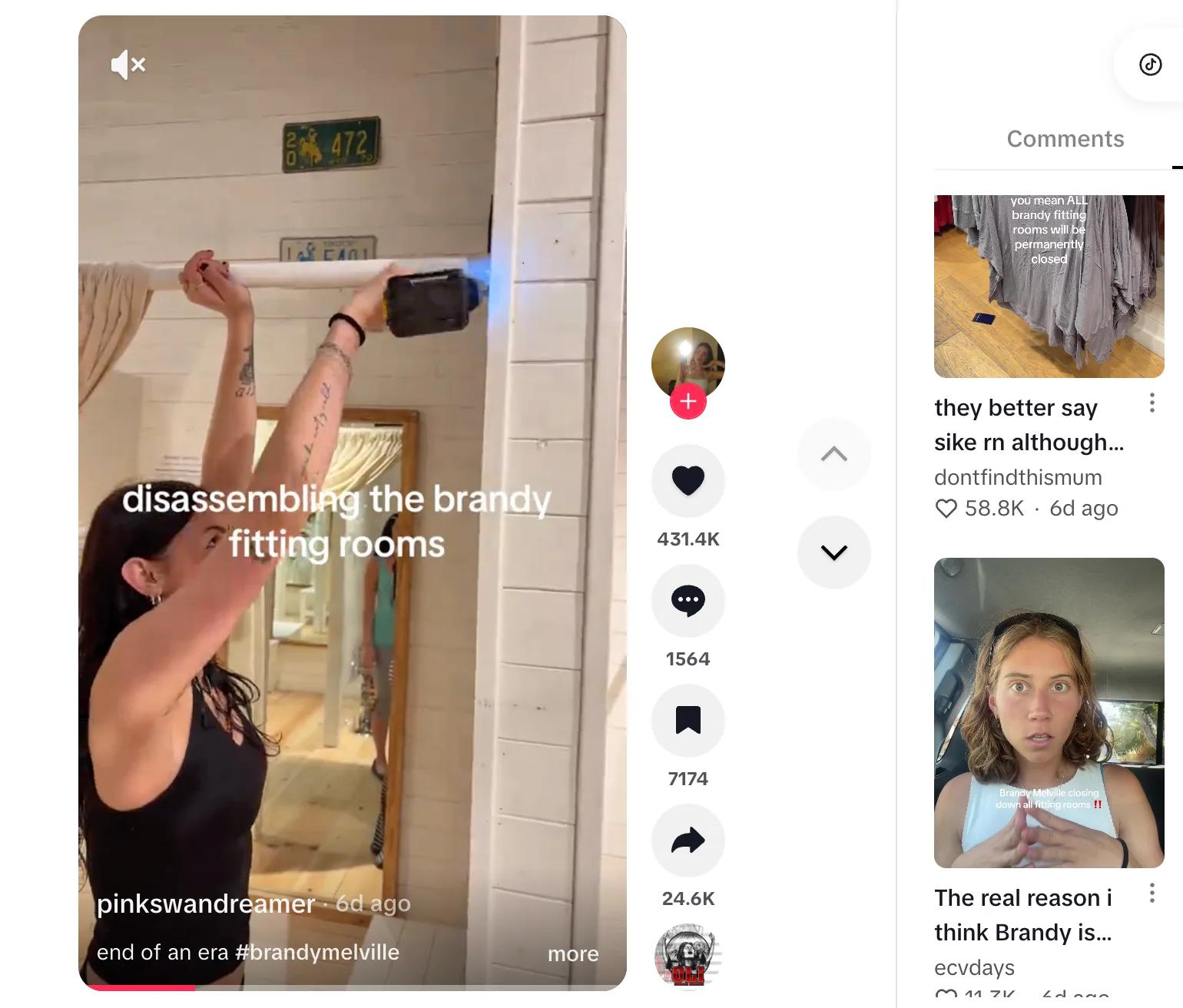
The backlash would be notable for any retailer. For Brandy Melville, it's compounded by context: the brand already carries no in-store return policy — purchases are exchange or store credit only. Removing fitting rooms while keeping that restriction in place is a rare double-down on friction. Customers noticed immediately, with social media full of comments pointing out that a multi-million dollar company could have simply installed curtain closures or added doors.
I’m extremely curious about the immediate and long-term impact on sales this move will have. I’m also wondering: will customers try clothes on over their clothes in the stores? Will associates monitor for that? And long term: if the brand reinstalls fitting rooms, how long will that take?
The broader CX lesson here is straightforward: when you eliminate a core piece of the in-store experience, you'd better have a clear explanation and a clear path forward. Silence and a shrug aren't a policy.
How 3 retailers are using AI for productivity, personalized shopping
Best Buy, Gap, and Dick's Sporting Goods are each deploying AI in meaningfully different ways:
- Gap's Gemini-powered shopping tools
- Dick's "Coach by Dick's" agentic AI adviser for personalized product and training recommendations
- Best Buy's OpenAI and Google partnerships
More than two-thirds of consumers used at least one AI shopping tool in the past three months, and McKinsey projects agentic commerce in U.S. retail could reach $1 trillion by 2030. The retailers winning with AI are building for usefulness, not just cost reduction.Check out our blog for more ideas: How Leading DTC Brands Use AI to Stay Lean and Competitive
Tune In
CX teams are getting leaner. AI is handling more. But here's what's not being talked about enough: the interactions that reach human agents today are harder, more emotionally loaded, and higher stakes than ever before. Plus, most teams are still being measured against benchmarks built for a completely different contact mix.
In the latest episode of CX Now, Jess Jackson, former frontline agent turned CX executive, puts a name to what's happening: the emotional labor crisis. She breaks down what's driving it, how to spot it on your own team, and what leaders can actually do to build CX organizations that are sustainable for the people inside them.
If you manage agents or make decisions about how AI shapes frontline work, this one's worth your time. Read the interview here.
AI Headlines
Who owns the customer truth in an AI-driven contact center? As AI agents take on more of the customer service load, fragmented data across CRM, CCaaS, and CDP platforms has gone beyond being an IT headache to a full-blown CX risk. Incomplete context leads to confident wrong answers, and customers notice immediately.
Anthropic argued that leading AI labs may eventually need to slow development so governments, institutions, and society can adapt. The company pointed to rapidly accelerating capabilities and growing challenges around governance, safety, and workforce disruption. The industry's biggest debate is shifting from what AI can do to how quickly organizations and governments can absorb the change.
Apple Unveils Siri AI at WWDC. Powered by Google's Gemini models, Apple's revamped Siri now supports text-based conversations and conversation history, putting it in the same arena as ChatGPT and Claude — though demos leaned toward simple task chains rather than complex, open-ended requests. Shares dropped 4% following the announcement.
Broadcom, Apollo Global Management, and Blackstone announced a new AI infrastructure initiative backed by $35 billion in initial funding. The platform aims to deliver more than 20 gigawatts of compute capacity by 2028 and support major AI companies including OpenAI and Anthropic. The AI race is increasingly becoming an infrastructure race. Access to compute may prove just as important as model innovation.
ChatGPT reached one billion monthly active users in the fastest time period ever: roughly three years, surpassing the growth trajectories of major platforms such as YouTube, Chrome, Instagram, and Google Maps. AI has moved beyond an emerging technology category and become a mainstream consumer behavior function at unprecedented speed.