B2B Customer Experience Demands a Different Foundation

B2B customer experience has always been different in what it demands of the teams responsible for it.
Your customer isn’t just one person. It’s a company. It’s the VP of Engineering who files a critical ticket at 11pm, the CFO who calls when something affects their quarter, and the executive sponsor who surfaces only when the relationship is at risk. Success is measured differently, too. As renewals, expansion, and retained revenue.
That is a fundamentally different job, and for too long, the software built to support it has not kept up.
The platforms most teams rely on today were not built with the account as the unit of work. They were built for individual tickets, individual contacts, and individual conversations. In a B2B environment where the account spans dozens of contacts, years of history, and multiple concurrent relationships, that architecture fails and your customers deserve better.
Reactive Support Is Not a Strategy
When teams lack a unified view of the account, they are always catching up.
Sentiment is deteriorating, but no one sees it until a stakeholder goes quiet. Ticket volume is climbing, but no one connects those dots until an executive escalates. A renewal is 60 days out, but the team responsible for that relationship is operating on incomplete information.
The best support teams do not just respond. They anticipate, surface problems before customers have to name them, and arrive at every interaction fully informed and positioned as partners.
That requires a platform built around the account.
We know this because we live it. Kustomer already serves over a hundred B2B and B2B2C companies, and what we heard from them, consistently, was the same thing: the relationship context was there, somewhere, but the platform was not surfacing it in a way that actually helped their teams. That feedback made one thing clear: we could do more. Today, we are taking the next step in that direction.
A Platform Built for B2B Success
Most customer experience platforms were designed to handle volume. Get the ticket in, get the ticket out. That model works in B2C, where velocity is what wins and the customer is an individual.
B2B does not work that way. Speed is important, but the stakes are higher, the relationships are longer, and the consequences of getting it wrong are measured in contract value, not customer satisfaction scores. A B2B team that operates reactively does not just frustrate customers. It loses them.
We built Kustomer to solve a different problem: how do you give every person who touches a customer relationship the full context they need to make that relationship better? In B2C, the answer is the individual customer record. In B2B, the answer is the account.
That shift changes everything. It changes how agents work, how CSMs prepare, how support leaders report, and how AI should behave. Every surface in the platform needs to be organized around the company, not the contact. Every insight needs to be evaluated against the health of the account, not the status of a single ticket.
That is what we have built.
B2B Is a Team Sport
One of the things that makes B2B so different is that the team responsible for the customer relationship is not just support. It’s composed of Customer Success Managers managing renewals, Technical Account Managers handling technical escalations, support leaders tracking SLAs, and account executives watching for expansion signals.
Most platforms are built for the agent queue. Everyone else is an afterthought. The Customer Success Manager exports a report. The account executive checks a different system. The support leader builds a dashboard in a third tool. By the time an escalation lands, the people who need context the most are the ones who have the least of it.
Kustomer is built for the full revenue team. Every role gets a contextually relevant view of the account, organized around the outcomes they are responsible for. Agents see conversation history and open escalations. Customer Success Managers see account health and renewal signals. Support leaders see company-level performance. Account executives see risk and expansion indicators.
The account is the shared unit of work. The platform is the shared workspace.
AI That Understands the Account: Concierge, Envoy, and Architect
AI is only as good as the context it operates from.
Most platforms have bolted AI onto existing architectures that were never designed for it. The result is AI that can summarize a ticket but cannot tell you what that ticket means for the relationship. AI that can deflect a question but cannot adjust its response based on whether the customer is a Tier 1 enterprise or a free-tier user.
Kustomer's AI products, Concierge, Envoy, and Architect, are built on a different foundation. Because the account is native to our platform, our AI has access to full account context: open escalations, sentiment trends, ARR, contract tier, relationship history. It does not just answer questions. It acts with account intelligence.
Kustomer Concierge handles customer-facing AI interactions grounded in who the customer is and what their account represents, not just what they asked.
Kustomer Envoy brings proactive, outbound intelligence to the account, surfacing risks and triggering the right actions before customers have to escalate.
Kustomer Architect gives teams the ability to configure, orchestrate, and optimize B2B workflows, building around how their business actually works, not a generic template.
This is what AI-native means in a B2B context. Not a copilot bolted onto a ticket queue. A system that understands the account and acts on it.
Surfacing What Matters, Before It Becomes a Problem
The question every B2B support leader should be asking is not how many tickets were resolved this week. It is which accounts are at risk right now, and what does the team need to do about it.
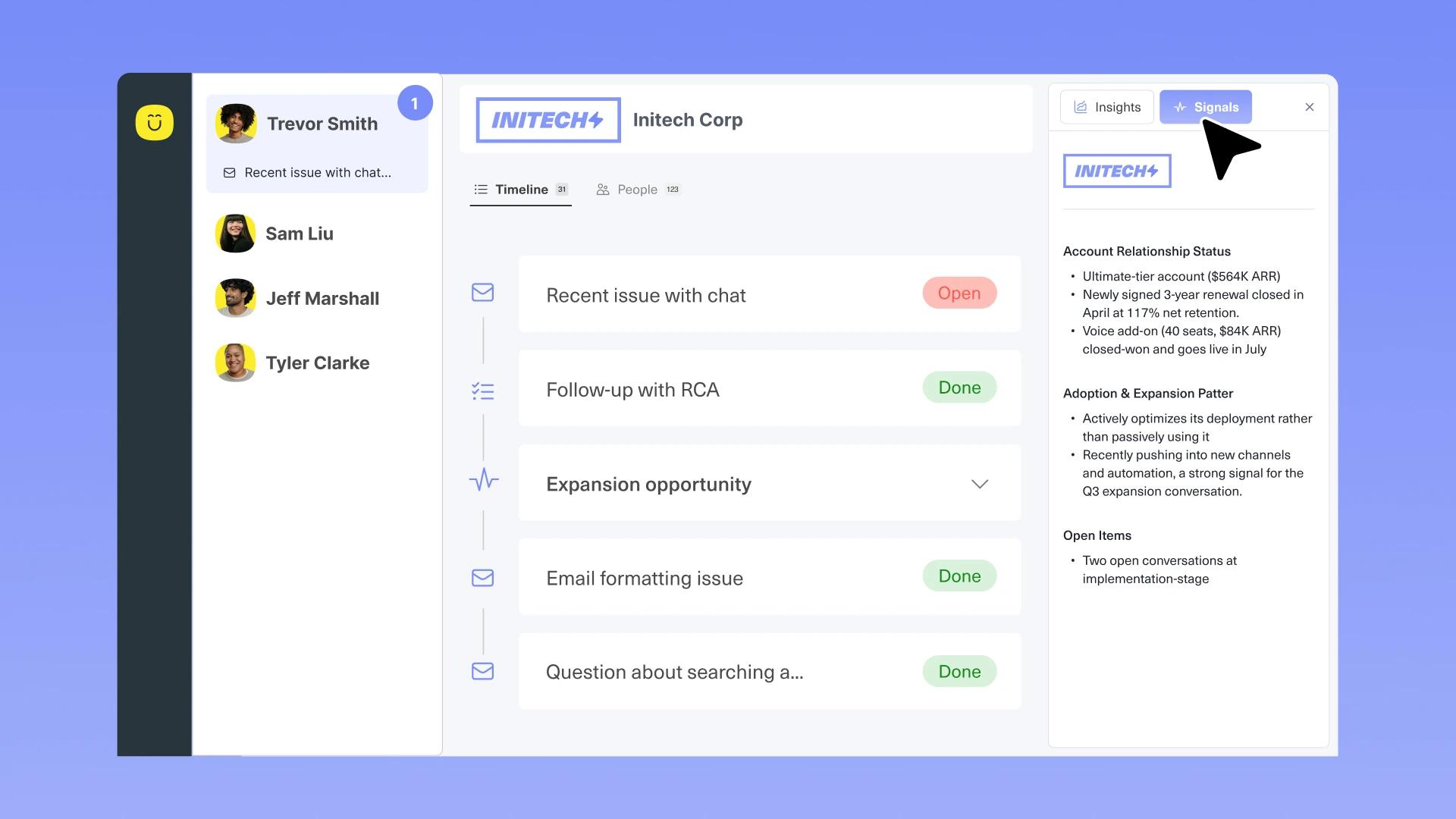
Kustomer Signals, our AI-powered intelligence layer that continuously analyzes customer interactions to surface patterns, risks, and trends your team would otherwise miss, now operates at the account level. Sentiment shifts, volume spikes, engagement gaps, recurring issue patterns: all of it visible at the company level, so teams can act before customers have to escalate.
We are also building a new Company Timeline: a unified account workspace that brings together every conversation, stakeholder, signal, and risk into a single chronological view. It is the home base B2B teams have needed, and the foundation everything else is built on top of. It is coming soon.
This is what we mean when we talk about making the account the unit of work. Not a concept. A workspace.
The Only Platform Built for B2B Account-Level Work
What we are building is not an incremental improvement to an existing category.
Kustomer is the only platform that brings together full conversational depth, native CRM maturity, and account-level AI that understands the relationships between each stakeholder and the account, in a single system purpose-built for the way B2B customer relationships actually work.
That combination matters. A CRM without conversational depth misses the operational reality of support. A support platform without CRM maturity cannot hold the account context that drives B2B outcomes. And AI without a strong underlying data foundation amplifies the problem instead of solving it.
We built our B2B platform on all three.
The teams that win in B2B are the ones that retain revenue, expand accounts, and build durable customer relationships. They are the ones that operate from complete context, surface risk before it becomes a problem, and arrive at every interaction prepared.
What Comes Next
The new Company Timeline and account-level Signals are coming soon. The roadmap ahead extends this foundation further with deeper company-level reporting, more AI context, and the integrations that bring the full revenue team into a shared view of the account.
We have been building toward this for a long time. Kustomer started with a belief that great customer service requires complete context. In B2C, that meant the individual. In B2B, it means the account.
The mission is the same. The scope has expanded to match it.