How Kustomer Workflows boost efficiency for customer service teams in financial institutions

Financial institutions face uniquely high stakes when delivering customer service challenges. Financial institutions must navigate a constant influx of sensitive and often complex inquiries while ensuring strict compliance with regulations, such as anti-money laundering (AML) and Consumer Financial Protection Bureau (CFPB) in the United States. Customer experience teams must juggle precision and regulatory pressure. At the same time, customers across all geographies expect both fast resolutions and airtight security. This combination of complexity, compliance, and customer demand raises the bar for modern customer support systems.
The Nutanix Financial Services Enterprise Cloud Index survey found that 96% of respondents reported that generative AI is affecting their data security concerns. But, financial institutions are still under pressure to automate and be more efficient to keep up with growing customer expectations.
Using automated workflows within your customer support software is a great option to speed up work around your customer experience team while your organization gets security-ready for AI and starts rolling that out strategically.
Keep reading to learn more about setting up workflows in Kustomer to improve efficiency within your customer experience team.
Real-world results: efficiency and accuracy gains
Kin Insurance migrated to Kustomer and thanks to native integrations and sophisticated workflows, Kin’s team could get a real-time data stream that their business intelligence team could build their reporting on. The best part? Technical business users could make a lot happen without requiring help from an engineer. And, this was also in line with their document retention and security policies - critical for financial services organizations.
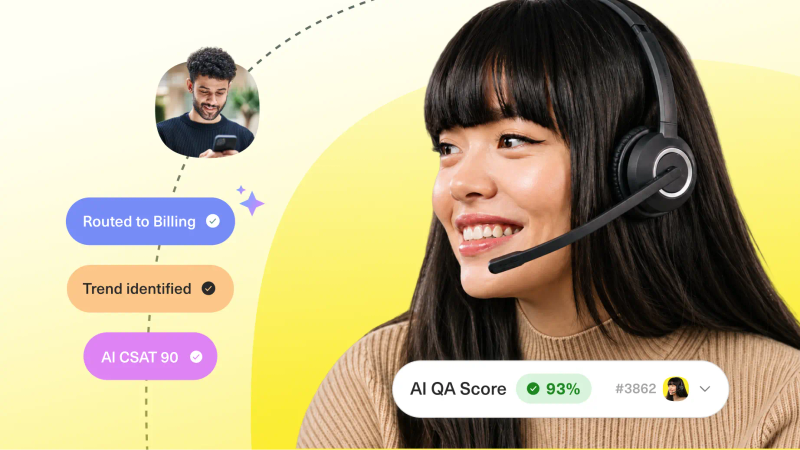
There are other meaningful outcomes too. Companies that take advantage of Kustomer workflows see a reduction in average handle time. And, in general, whenever customer experience teams automate repetitive work, their agents’ job satisfaction increases and turnover can decrease.
Key challenges financial service teams face
Many of the key challenges that customer experience teams within financial services organizations face revolve around repetitive work and/or using multiple systems.
- Updating multiple systems manually or manually escalating issues can increase average handle time
- Passing customers to find the right team member who can solve their issue can decrease CSAT
- Fragmented data silos leads to less effective strategic decision-making
Another key challenge? Building and maintaining customer trust. A 2023 study found that 66% U.S. adults say they trust banks. Delivering a reliable, high-quality customer experience is key to building that trust with financial institution customers. Financial services platforms can make headway in delivering high quality, speedy customer support by leaning on automated workflows within their customer experience teams.
You may be asking yourself: if AI is the next big thing in tech, why would my team spend time setting up Workflows? In fact, they work even better together. Setting up Workflows will set you up for success with AI, since Kustomer’s workflows work with bidirectional handoff with AI Agents teams. So whether your organization is ready to roll out AI pronto or needs some time to implement it, setting up workflows now will complement AI, not compete with it or be redundant.
How Kustomer workflows address these pain points
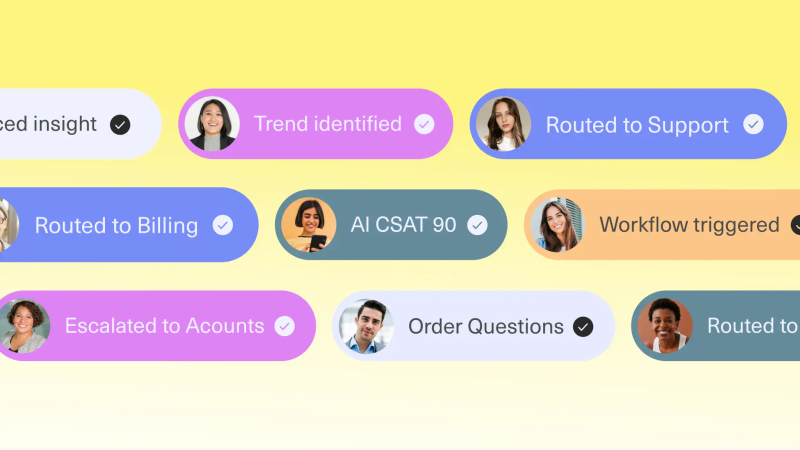
Some organizations have over 100 Workflows set up within Kustomer, and they can be highly customized to your organization’s needs and work within your tech stack. Here are some specific ways that Kustomer Workflows can serve your financial services organization:
Routing
Routing allows you to organize and collect conversations or tasks and route them to your agents using a set of criteria defined in queue rules. Routing conversations allows you to:
- Accurately calculate the estimated wait time
- Track and monitor user availability
- Measure team capacity against inbound volume for scalability
- Route custom tasks to teams
Kustomer makes it easy to route the right issues to the right team member for the job. Skills based routing allows you to route incoming conversations based on specific attributes your agents have, such as languages spoken, certifications, region, escalation level, or client service level. This is particularly useful for financial services organizations that need to ensure qualified representatives assist customers - for example, to a licensed mortgage loan officer or securities representative.