From Deflection to Outcomes: Introducing Kustomer Architect
For years, the CX industry has celebrated a metric that was never designed to measure what we actually care about.
Deflection rates. Handle time. Containment scores.
These are workload metrics. They tell you how many conversations did not reach a human. They tell you almost nothing about what happened to the customer after that. Whether they came back. Whether they stayed. Whether they told someone else to avoid your brand entirely.
We built an industry around optimizing for the wrong thing.
The Real Problem Was Never the Tools
When AI arrived in customer service, most platforms did what they always do when the market shifts. They bolted it on.
They added an AI layer on top of ticket-based systems that were never designed to understand the whole customer. They connected chatbots to knowledge bases that lived in four different places. They shipped deflection tools that resolved queries on the surface while leaving the underlying data fragmented, the workflows disconnected, and the human agents with even less context than before.
The result is what I hear from CX leaders constantly: "Our AI is working, but it's not actually resolving anything end-to-end."
That is the right diagnosis. Deflection is happening. Resolution is not.
And the gap between those two things is where customer loyalty is lost quietly, one interaction at a time.
The Path That Actually Works
Every CX team today faces a version of the same choice.
They can bolt AI onto an existing support platform. It feels safe. It creates more fragmentation.
They can buy standalone AI tools. It feels modern. Those tools lack the context, the workflow depth, and the operational grounding needed to transform anything.
Or they can rethink the foundation entirely. A platform built for AI, humans, and outcomes from the start. Not AI added later. Not intelligence layered on top of a ticket queue. A system where the goals layer, the execution layer, the data layer, and the observability layer are the same system.
That is the only path where closing the loop between what you need AI to achieve and whether it is achieving it becomes operationally possible.
Kustomer has always been built for that third path.
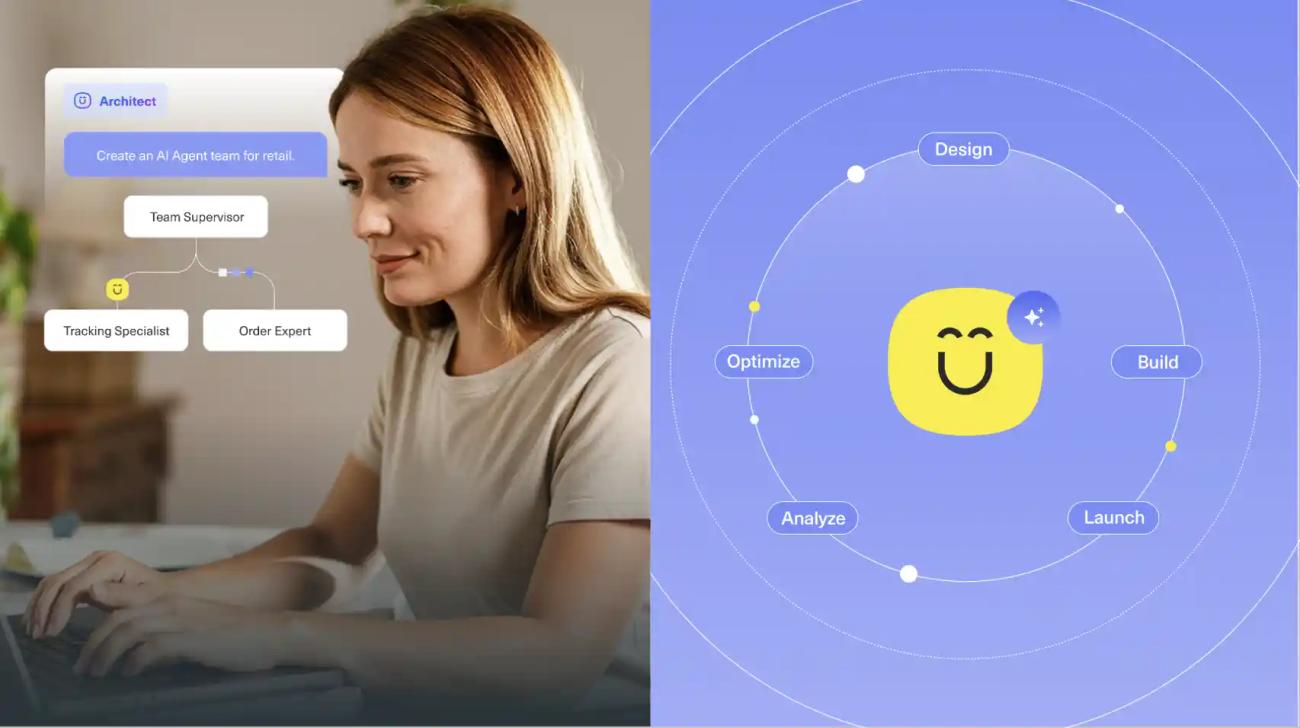
Today, we are making it clearer, more powerful, and more accessible with the introduction and culmination of Kustomer Architect.
Kustomer Architect: Goals-Driven AI for the People Who Know Your Customers Best
The most consistent thing I hear from CX leaders is not that they lack vision. They know exactly what outcome-driven customer experience should look like for their business.
What they lack is the path from that vision to production. The implementation cycle is too long. The dependency on engineering is too deep. The gap between what a CX operator wants to build and what they can actually build without a developer in the room is too wide.
Architect was built to close that gap.
Goals-Driven AI
Most AI workflow tools ask you to define procedures. You specify what the AI should do in a given situation and hope it follows the instructions reliably.
Architect takes a different approach. You define the outcome you are trying to reach: retain this customer, resolve this issue, protect this relationship; and the platform works backwards from that outcome to orchestrate the right combination of AI, workflows, and human collaboration.
That is not a subtle distinction. It is the difference between automation that follows a script and AI that pursues a result.
Built for CX Operators, Not Engineers
The people who understand your customers best are not your engineers. They are your CX operators. Your team leads. The people who have been designing support experiences for years and know exactly where things break.
Architect gives those people the ability to define how AI should behave: what it can decide on its own, where it should escalate, how it should handle edge cases, what outcomes it is optimizing for. They describe how they want their business to run. Architect figures out how to make that happen inside the platform.
Sophisticated, complex, highly customized AI workflows. Built by the people who know the customer.
Grounded AI, Not a Black Box
Architect does not operate in isolation. It has access to the full Kustomer platform: customer data, conversation history, workflows, knowledge, and your human agents. When AI makes a decision inside Architect, it is grounded in the complete operational and customer context behind that interaction.
That is what separates this from tools that work in demos and break in production.
We are also open by design. Architect speaks MCP (Model Context Protocol) which means our agentic platform can connect to anything that exposes an MCP server. Your order management system. Your returns platform. Your recommendation engine. Your internal data sources. Great AI workflows are only as good as the data they can see, and we made the deliberate decision not to lock teams into our data model. Connect the ecosystem your business already runs on.
Human-in-the-Loop Where It Matters
Automation scales service. It does not replace judgment.
Architect is built around the belief that humans belong in the moments that require empathy, creativity, and trust. The platform gives teams the controls to configure exactly where AI acts on its own and where it hands off to a human, with AI confidence thresholds, built-in testing, live monitoring, and escalation rules.
The goal is not fully automated CX. The goal is the right work routed to the right resource at the right moment. Every time.
What This Proves in Practice
HexClad is one of the brands that got there first.
They came to Kustomer with a real operational challenge: managing high contact volume, maintaining strong customer satisfaction, and doing both without scaling headcount linearly with revenue. What they found was the ability to reduce cost-to-serve without sacrificing CSAT.
Not a trade-off between cost and experience. Both, simultaneously.
"The value isn't better tools; it's lowering cost-to-serve without sacrificing CSAT. They speak the metrics we care about: deflection, headcount optimization, faster resolution, and revenue protection. Kustomer helps HexClad reduce cost while improving customer loyalty. They've become essential to us," said Andrew Jobson, Global Head of Customer Service, HexClad.
That combination, lower cost and better experience, is what the revenue driver argument actually requires. If you are cutting costs by degrading experience, you have not solved anything. You have just deferred the churn.
The Shift We Are Building Toward
AI in customer service has been measured by the wrong standard for too long.
Did the bot resolve the ticket. Did handle time go down. Those metrics tell you almost nothing about whether AI is making the business better.
The brands getting this right are measuring differently. Customer retention influenced by support interactions. Revenue protected through CX interventions. Lifetime value correlated to resolution quality. Those numbers live in a P&L, not a support dashboard.
Kustomer Architect is how we help CX teams get there. Not by adding another tool to the stack. By replacing the question entirely.
The question is not how do we deflect more tickets. The question is how do we use AI, data, workflows, and human expertise together to improve the entire customer experience.
That is the platform we have always been building. Architect makes it more configurable, more accessible, and more directly connected to the business outcomes that define modern CX.
Customer experience should start at hello, not help. Every interaction is an opportunity to delight, retain, and grow the customer relationship.
We are building intentionally toward that vision. And we are just getting started.