Introducing Internal Threads: Keep all context in Kustomer

Kustomer's Internal Threads with Slack isn't just a feature. It's a decision about what kind of service operation you want to run.
There is a conversation happening right now about your customer.
Your agent can't find the answer. So they minimize the window, open Slack, find the right channel, type the question, and wait. Maybe they get a response in three minutes. Maybe three hours. The customer is still on the other end, assuming someone is working on their problem.
The expert eventually replies. The agent copies the information back into the customer conversation. Closes the loop (almost).
The Slack thread stays in Slack. The customer record stays incomplete. The supervisor sees nothing. The next agent sees nothing.
The conversation nobody can see is the one that decides everything.
It doesn't have to work this way.
You should be able to get answers in Slack and keep the context in your customer record.
The Split Between Official and Actual Work
Here is the problem with most CX operations: the official record and the actual record are two different things.
Answers happen in Slack. The record lives in your CX platform. And they rarely meet.
The official record is clean, structured, auditable.
The actual record is scattered across Slack channels, text messages, and the institutional memory of your best agents. When they leave, it goes with them.
You cannot improve what you cannot see.
And most leaders cannot see the internal work that surrounds every complex customer interaction. They see the outcome (i.e., resolved or unresolved, time to close, CSAT) but not the process. Not the waiting. Not the uncertainty. Not the calls made into the void.
The Hidden Cost of Context Switching
CX leaders invest heavily in agent experience. Fewer examine honestly what agents are actually doing between interactions.
More often than not, the answer is context-switching.
The constant toggling between platforms. The retyping of information that already exists somewhere else. The mental overhead of managing two parallel conversations — one with the customer, one with the person who actually has the answer.
The best agents absorb this friction without letting it show. Others lose time.
Customers, in either case, wait longer than they should.
This is not fundamentally a technology problem. It is a workflow design problem.
The process was built for an era when agents and subject matter experts sat in the same building. That model no longer reflects how modern service operations work.
A Different Way to Work
Kustomer's Internal Threads with Slack is a focused capability with significant operational implications.
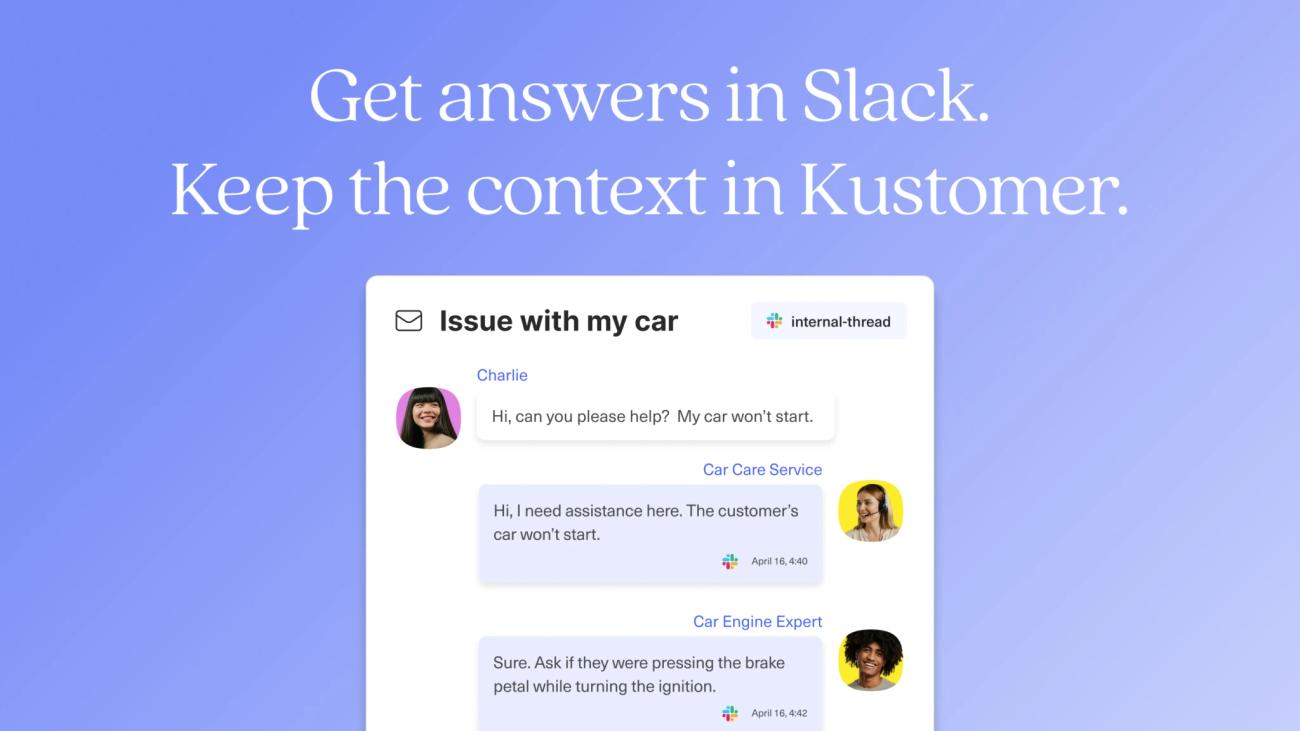
When an agent needs expert input, they initiate a Slack thread directly from the Kustomer conversation without leaving the platform.
The specialist on the other end — a field technician, logistics partner, back-office team member — receives the request in Slack and responds there.
Agents get answers where work is already happening: Slack.
And every reply is automatically captured in real time, in chronological order, directly on the Kustomer timeline.
Get answers in Slack. Keep the context in Kustomer.
The customer never sees it. The supervisor always does.
What Actually Changes
When every internal conversation is captured in the timeline, everything changes.
Accountability
When internal coordination is invisible, no one owns it. When it is on the record, someone does.
Coaching
Supervisors can see not just what the agent said, but how long they waited for help — and from whom.
Expert Experience
The field technician never needs to learn Kustomer. They stay in Slack. But their input becomes part of the permanent customer record.
Auditability
When a customer escalates and someone asks, “What actually happened here?” the answer is on the timeline. All of it.
Beyond Notifications: True Collaboration
Most CX platforms treat Slack as a notification endpoint — a one-way alert that tells someone a conversation exists.
Kustomer treats Slack differently.
Internal Threads with Slack makes Slack a collaboration layer that's bidirectional and embedded directly in the customer record.
Threads appear inline on the timeline, chronologically, alongside the customer conversation. No separate panel. No second system to check.
The supervisor sees one complete canvas.
Because the work that happens in Slack is no longer separate from the record in Kustomer.
Who This Matters to Most
The leaders who will move on this immediately already know the problem is real.
They operate decentralized support teams — agents who rely on expertise from people outside the platform, outside the office, sometimes outside the company. They've been managing it with workarounds, and they're tired of them.
For them, this is not a feature evaluation. It is a resolution.
Others will take more time.
They see inefficiencies in the numbers — handle time, escalation rate, repeat contact rate — but haven't yet connected those metrics to the Slack threads happening behind the scenes.
That connection is worth making.
If It’s Not Recorded, It Doesn’t Improve
If your agents are leaving the platform to get help, that exchange is not part of the customer record.
And if it is not recorded, it cannot be analyzed, coached, audited, or improved.
The organization remains dependent on informal systems — and on the hope that people manage them consistently.
That is a reasonable bet. Until it isn't.
How to Get Started
Kustomer's Internal Threads with Slack solution is available now to all Kustomer users.
If you're already a customer, check out the Help article or talk to your Customer Success Manager.
If you're not, and this problem sounds familiar, book a demo.
One Final Thought
Your agents will always need answers from Slack.
The question is whether that context makes it back into your system.
It should.
Get answers in Slack. Keep the context in Kustomer.