


We’re not going to sugarcoat it – SolarWinds Service Desk is falling behind.
Modern IT teams are complaining about multiple issues– from a tedious setup process to limited automation capabilities.
Combine that with the tool’s higher-end pricing and it only becomes more challenging to justify sticking with SolarWinds when there are faster, more user-friendly alternatives available.
The good news is that you do have options.
Whether you’re looking for better automation, more beginner-friendly interfaces, or a more cost-effective option, we’ve got you covered.
Why Look for an Alternative to SolarWinds Service Desk?
Here are some common reasons why businesses look for alternatives to SolarWinds Service Desk:
- Random edit modes: Sometimes, clicking on a ticket unexpectedly throws you into edit mode, and there’s no option to turn it off altogether. [See G2 Review]
- No live ticket update indicator: When someone is working on a ticket, there’s no signal showing that it’s being updated, which leaves other agents in the dark and can cause overlaps. [See G2 Review]
- Higher pricing compared to competitors: SolarWinds is pricier than most alternatives. For example, SolarWinds pricing starts around $145 monthly, compared to Kustomer’s $89 per user per month. And it can get significantly higher based on the features you need. [See G2 Review]
- No automated ticket management: There’s no option to set automatic reminders or close tickets if end users don’t respond, so agents must follow up manually. [See G2 Review]
- Lack of official language support: There’s no built-in support for different languages, so users have to rely on third-party translation add-ons. [See G2 Review]
Key Features to Look for in a SolarWinds Service Desk Alternative
Now, let’s check out the key features your business should consider when looking for an alternative to SolarWinds:
- Customizable workflows: You should be able to customize workflows to match your specific processes without complex coding. This is especially important for teams with unique workflows or companies with multiple departments.
- Robust ticket management: Look for a solution that offers real-time updates, collaboration features like comments or tagging, and automatic ticket assignment to reduce manual work.
- Multi-channel support: You’ll want a tool that pulls together customer requests from email, chat, phone, or even social media into one place. This ensures that your team doesn’t have to jump between tools, and you can respond faster.
- Strong reporting and analytics: Good reporting features are necessary for tracking response times, agent performance, and customer satisfaction. A good alternative should make it easy to get insights to improve your service without having to dig through raw data.
- Automated reminders and ticket closure: Instead of manually checking in on tickets that have stalled, find a tool that automatically sends reminders to customers or agents after a set time. If no one responds, it should be able to close the ticket on its own.
- Seamless integrations: Make sure that you can easily connect the new tool to your existing software, like CRM, asset management systems, or Slack.
- Multi-language support: If you’re working with a global audience, look for built-in support for multiple languages. You want your team to be able to communicate with everyone easily, without relying on third-party translation tools.
Should You Look for a Cloud-Based or On-Premises Solution?
Cloud-based solutions let your team work from anywhere and take the hassle out of updates and maintenance since that’s all handled by the provider.
They’re perfect if you’ve got remote workers or don’t want to deal with the upkeep yourself.
On the other side, if you want full control over your data and need more customization, on-premises might be the way to go. However, it usually means more responsibility for your IT team and higher upfront costs.
SolarWinds Service Desk Competitors at Glance
| Alternative | Key Features | Best For | Pricing |
| Kustomer | AI-powered automation Full CRM integration Omnichannel support Advanced analytics Scalability and flexibility | Ideal solution for businesses of all sizes | Starts at $99/user/month |
| Freshservice | Incident managementAsset trackingSLAs | Best for IT departments in mid-sized companies | Starts at $19 per user/month |
| ServiceNow ITSM | AI automationUnified platformCustomizable workflows | Best for large organizations with complex workflows | Pricing varies based on features and setup |
| Jira Service Management | Knowledge managementDynamic formsAsset management | Best for companies already using Atlassian products | Starting at $18 per agent/month |
| ManageEngine ServiceDesk Plus | AI-powered automationMulti-site managementCustom actions | Best for SMBs that need scalable solutions | Starts at $13 per technician/month |
| SysAid | AI-powered ticketingAsset managementService automation | Educational institutions and financial firms | Custom pricing based on company size |
| Zendesk | AI-powered chatbotsCustom CXDetailed reporting | Healthcare and travel industries | Starts at $19/user/month |
| InvGate Service Desk | GamificationCollaboration toolsCustomizable workflows | Logistics and supply chain companies | Starts at $17 per agent/month |
| Freshdesk | Freddy AI assistantMobile app supportCustomizable workflows | Real estate agencies | Starts at $15 per agent/month |
| Salesforce Service Cloud | Omni-channel routingReal-time insightsAI-powered automation | Retail businesses and government agencies | Starts at $25/user/month |
| Zoho Desk | AI-powered assistant (Zia)Customizable workflowsKnowledge base | Freelancers, software development teams | Starts at $14/user/month |
1. Kustomer
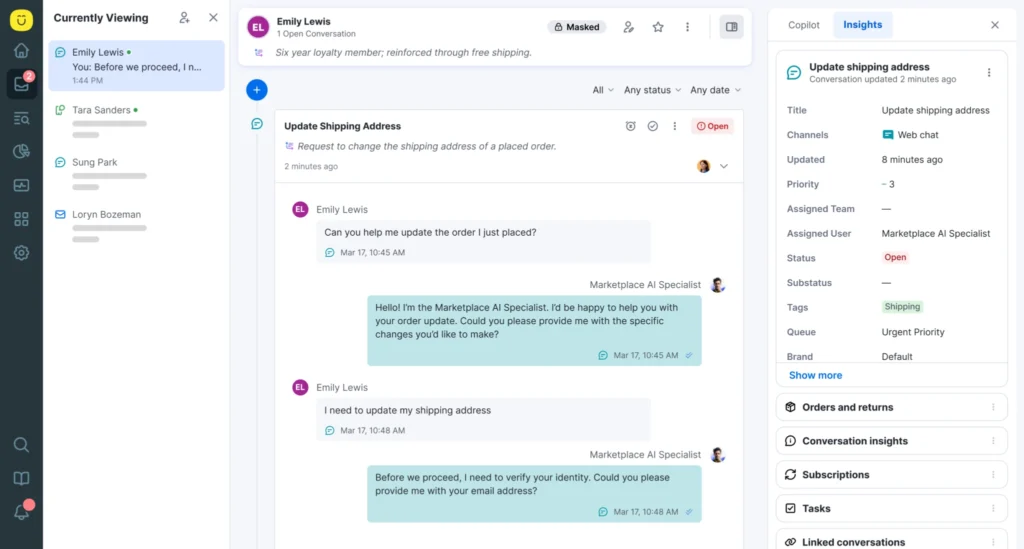
Kustomer is omnichannel customer service software that makes it easier for organizations to manage interactions on various communication channels – including email, social media, chat, SMS, and phone.
It offers a more comprehensive solution compared to SolarWinds, with a CRM-centered approach that consolidates customer data and interactions into a single timeline. This gives agents the full context they need to quickly resolve issues without relying on ticket-based systems.
For mid-sized to enterprise-level companies handling high volumes of inquiries, Kustomer can be particularly helpful with its deep CRM integration and automation features. You can streamline workflows, automate repetitive tasks, and use AI-driven tools like chatbots and sentiment analysis to optimize for efficiency.
Key Features of Kustomer
- Unified platform: Kustomer brings all customer interactions—whether through social media, email, chat, or phone—into one easy-to-read interface.
- AI-powered automation: Kustomer has built-in smart workflows that can automate ticket routing, customer engagement, and even generate proactive responses based on real-time data insights.
- Advanced analytics: The platform provides real-time metrics and analytics, so businesses can monitor agent performance, track customer engagement, and make better decisions without having to sit through spreadsheets of data.
- Scalability and flexibility: With Kustomer’s scalable infrastructure and native support for popular social media channels like Twitter, Instagram, and WhatsApp, businesses can manage increasing workloads without sacrificing quality.
- Comprehensive integrations: Kustomer integrates with top business software like Facebook, BigCommerce, Dialpad, and more, so businesses can fully integrate their customer service platform with their tech stack.
- Self-service capabilities: Kustomer includes an intuitive self-service portal that customers can use to resolve issues independently.
- Mobile accessibility: Kustomer’s dedicated iOS app allows agents to provide top-notch customer service on the go.
Why Do Companies Choose Kustomer Over SolarWinds Service Desk?
One of the main reasons why companies opt for Kustomer over SolarWinds is its robust automation capabilities. SolarWinds relies on more manual processes, whereas Kustomer’s built-in automation tools significantly reduce the time spent on repetitive tasks.
Kustomer also has more advanced omnichannel support that covers a wider range of communication channels like social media and messaging apps, which SolarWinds lacks in native integration.
And while SolarWinds can be a challenge to set up and scale, Kustomer is the opposite – it makes it easier to grow your customer service operations without sacrificing efficiency.
What real users are saying about the benefits of Kustomer:
- What I like best about Kustomer is the easy navigation of every conversation ticket, the side panel tools, plus the capability to use pre-made email macros for quick messaging to customers [*]
- Kustomer is customizable and the most user-friendly option we have seen, and we have tried them all. [*]
- I like how Kustomer displays all of the Customer's history and facts (chat, call, emails, and SMS), making it easier to deliver information to customers, and all of this in an easy and welcoming user-face experience with a really easy and adaptable interface. [*]
Advantages of Using Kustomer
- Comprehensive CRM integration: While SolarWinds Service Desk does offer some customer support tools, it primarily focuses on IT service management and ticketing. Kustomer, on the other hand, goes beyond just support tickets with its fully integrated CRM system and provides a comprehensive view of the entire customer journey. Businesses can consolidate customer data, past interactions, and needs into a unified platform, something SolarWinds doesn’t prioritize.
- AI agents for customers: Kustomer outshines SolarWinds with its built-in AI-driven automation tools. These features handle routine tasks like smart ticket routing, predictive analytics, and chatbots for real-time customer interactions. SolarWinds, on the other hand, offers more limited automation capabilities, which often require manual intervention and don't integrate AI in the same seamless way that Kustomer does.
- Omnichannel support: SolarWinds Service Desk focuses primarily on email, ticketing, and IT service management functions, which limits its omnichannel functions. Kustomer, on the other hand, is built for omnichannel customer engagement, offering native integrations with platforms such as Twitter, Instagram, Facebook, WhatsApp, and SMS, in addition to traditional channels like email and phone.
What real customers are saying about Kustomer
- “Kustomer helped us scale in a way that improved both efficiency and quality. Today, customer satisfaction is up 40%, and our team can focus on high-value conversations that require empathy and expertise. It’s allowed us to grow without sacrificing the human experience.” — Alex Wieland, Co‑Founder and CRO, APLAZO [Read Case Study]
- “Kustomer’s search and custom attributes give us the ability to double click into emerging customer issues to diagnose patterns, and fix problems faster." — Sarah Inbar, Director of Customer Support, Smalls [Read Case Study]
- “Kustomer pulls all customer information on one timeline. We see a customer’s full history right there, without switching around. That’s been a game-changer for us.” — Taylor Johnson, Director of CX, Nathan James [Read Case Study]
2. Freshservice
Freshservice is a cloud-based IT service management (ITSM) software that simplifies internal operations with features like automated workflows and incident management.
It is a go-to choice for teams that want to improve service desk efficiency without wasting valuable time on complex setups.
Key Features of Freshservice
- Incident management: You can keep everything on track with an easy-to-use ticketing system that helps you prioritize, track, and resolve IT issues.
- Self-service portal: Your customers can solve problems on their own with a simple knowledge base and service catalog.
- Asset management: You can stay on top of your hardware and software inventory with real-time tracking and insights.
- Service level agreements (SLAs): Track team performance by setting up SLAs that automatically track progress and resolve any delays before they become a problem.
- Integrated knowledge base: Freshservice can help you build an internal knowledge base as a go-to resource for your team.
- Multi-channel support: Give your users an option to raise tickets via email, phone, chat, or the portal.
Why Do Users Like Freshservice?
- Reliable and flexible ITSM solution
- Freshservice is easy to integrate and covers most of our needs
- I like the hassle-free setup and the easy-to-use UI
Who is Freshservice a Good Fit For?
- IT departments in mid-sized companies: Freshservice can manage internal service requests and incidents efficiently.
- Companies that need ITIL-compliant solutions: The platform delivers structured, best practice-driven IT service management.
- Organizations that want asset and change management tools: Freshservice can track IT assets and reduce the risks associated with infrastructure changes.
What Are Some Limitations of Freshservice?
- Poor agent interface: Agents report that the interface requires excessive scrolling and clicking, unlike other tools that can fit more content on the screen. [See G2 Review]
- High price for limited features: Users feel that the pricing doesn't align with the value provided by the current feature set. [See G2 Review]
- Limited integrations: There are fewer integration options with other programs compared to competing platforms, which limits flexibility. [See G2 Review]
Freshservice Pricing
Freshservice offers four pricing plans:
Starter plan: Starts at $19 per user per month and includes basic features such as incident management and access to a knowledge base.
Growth plan: Starts at $49 per user per month and it adds asset management, a service catalog, and approval workflows.
Pro plan: Starts at $95 per user per month and it includes advanced features like problem and change management, project management, and SaaS management.
Enterprise plan: Starts at $119 per user per month and it provides full capabilities, including Freddy virtual assistant, audit logs, and enhanced orchestration features.
3. ServiceNow ITSM
ServiceNow is a cloud-based platform that helps organizations automate their workflows across various departments like IT, customer service, and HR.
The platform was built to reduce manual work, speed up processes, and improve decision-making by connecting data and systems.
Key Features of ServiceNow ITSM
- AI-powered automation: ServiceNow uses advanced customer service AI to automate workflows, predict problems, and suggest solutions.
- Unified platform: The platform improves efficiency by integrating various business processes and systems into one platform.
- Customizable workflows: ServiceNow gives you the option to create custom workflows based on your needs with low-code tools.
- Enhanced IT security features: The platform uses robust encryption and access control to safeguard data and detect potential threats.
- Mobile accessibility: ServiceNow’s mobile app lets users manage tasks, view reports, and collaborate on the go.
- Seamless integration: It offers ready-made connectors for popular tools like Microsoft Teams and Slack.
Why Do Users Like ServiceNow ITSM?
- ServiceNow follows the ITIL process out of the box and has a lot of flexibility for every standard process
- Feature-rich and user-friendly IT asset management
- It keeps configuration data in one place to ensure consistency across different environments
Who is ServiceNow a Good Fit For?
- Large organizations: ServiceNow is well-suited for large organizations that need to automate and streamline complex workflows across departments.
- IT management teams: The platform is ideal for IT teams that need tools for managing incidents, changes, and service requests.
- Companies with a variety of systems: ServiceNow works well for businesses that need to integrate diverse software and platforms into a combined system.
What Are Some Limitations of ServiceNow ITSM?
- Clunky interface design: Users report that the interface is not intuitive and requires multiple steps to navigate and complete tasks. [See G2 Review]
- Customization challenges: Many users find that customizing the platform involves too many steps and requires additional work to get what they need. [See G2 Review]
- Limited offline functionality: ServiceNow offers limited access to features when offline, which can be a drawback for teams that need remote or offline service. [See G2 Review]
ServiceNow Pricing
ServiceNow’s pricing depends on factors like the number of users, the modules you need, and how much customization is required.
On average, costs range from $70 to $100 per user per month.
For larger setups, implementation fees can start around $60,000, including setup and annual maintenance.
Costs increase if you need advanced features or add-ons like AI capabilities or more customized setups.
4. Jira Service Management
Jira Service Management is a tool from Atlassian that helps teams manage IT service requests, incidents, problems, and changes from a single platform.
The platform integrates with other Atlassian products like Jira Software and Confluence, which makes it easier for IT, development, and business departments to collaborate.
Key Features of Jira Service Management
- Real-time collaboration: IT and development teams can work side by side, with Jira tickets seamlessly linking to service management tasks.
- Virtual agent: Uses AI to handle simple requests, directs tickets to the right teams, and offer helpful solutions from your knowledge base.
- Knowledge management: Jira connects users to a well-organized knowledge base and helps them find answers on their own.
- Dynamic forms: Automatically updates forms based on user input and show only what’s needed so agents get the right info without the clutter.
- Asset management: Jira can keep track of your IT assets from start to finish to avoid unnecessary losses.
Why Do Users Like Jira Service Management?
- I find Jira Service Management really easy to use. The interface is simple to navigate, and managing projects feels smooth and efficient.
- I love the option to add multiple users to a ticket as participants
- Jira makes remote support and ticket management easy
Who is Jira Service Management a Good Fit For?
- Companies within the Atlassian ecosystem: Ideal for businesses already using Jira or Confluence, with smooth integration across the tools.
- Teams that need custom workflows: Perfect for organizations that want to tailor workflows to their specific service management needs.
- Growing businesses: A good fit for growing companies that want scalable service management without being overwhelmed by complexity.
What Are Some Limitations of Jira Service Management?
- Challenging to optimize at first: Users report that getting the system set up and optimized can be difficult, especially when you’re just starting out. [See G2 Review]
- Lacks pre-configured processes: Unlike other service management tools, Jira Service Management offers minimal out-of-the-box configurations and leaves much of the setup to the user. [See G2 Review]
- Notification system needs improvement: Many users feel that the notification system could be more effective and customizable. [See G2 Review]
Jira Service Management Pricing
Jira Service Management offers four pricing structures:
- Free plan: Includes basic features like request management for up to 3 agents at no cost.
- Standard plan: Starts at $18 per agent per month, offering features like SLA tracking and customizable workflows.
- Premium plan: Starts at $44 per agent per month, with advanced incident management and unlimited storage.
- Enterprise plan: Customizable for larger businesses, with pricing based on specific needs and organization size.
Related reading: 16 Best Jira Service Management Alternatives for 2026 & Beyond
5. ManageEngine ServiceDesk Plus
ManageEngine ServiceDesk Plus is a service management tool built to simplify how teams handle operations and it’s a popular choice for IT teams looking to implement best practices like ITIL.
Key Features of ManageEngine ServiceDesk Plus
- AI-powered automation: The platform automates routine tasks like ticket categorization and assignment.
- Multi-site management: Handle multiple locations from a single platform, each with its unique workflows and settings to fit specific needs.
- Service desk scheduler: A built-in scheduling tool allows technicians to manage requests, tasks, and their time from one central calendar.
- Custom actions: Sets up automated task triggers and notifications throughout the service lifecycle.
- Software license management: Tracks software licenses, and monitors usage, to avoid unnecessary costs.
- Inventory catalog: Creates a centralized catalog of IT products to improve your resource management.
Why Do Users Like ManageEngine ServiceDesk Plus?
- ServiceDesk Plus is one of the best ITSM tools that I have used
- ManageEngine has solid customer support
- ServiceDesk Plus is super easy to integrate with other ManageEngine products
Who is ManageEngine ServiceDesk Plus a Good Fit For?
- Healthcare and education sectors: ManageEngine ServiceDesk Plus works well for industries like healthcare and education, where IT teams manage a variety of non-IT assets and require strict compliance and monitoring.
- SMBs looking for scalable solutions: A good fit for small and mid-sized businesses that need a cost-effective solution with room for growth.
- Organizations with strict compliance requirements: Great fit for businesses that require advanced tracking of software licenses to meet compliance regulations and avoid penalties.
What Are Some Limitations of ManageEngine ServiceDesk Plus?
- Occasional bugs: Some users report bugs that disrupt workflow and require some time to resolve. [See G2 Review]
- Lack of onboarding support: Users complained about a lack of onboarding training or user guides. [See G2 Review]
- No 24/7 support: The absence of 24/7 customer support is a common issue, with many users wanting round-the-clock assistance. [See G2 Review]
ManageEngine ServiceDesk Plus Pricing
Here’s a quick overview of ServiceDesk’s pricing tiers:
- Standard Edition: Starts at $13 per technician per month for basic IT help desk services.
- Professional Edition: Starts at $27 per technician per month and it includes asset management features.
- Enterprise Edition: Starts at $67 per technician per month and adds asset, change, and project management tools.
Prices increase based on the number of technicians and nodes, with plans starting from 2 technicians and 250 nodes and scaling up to 200 technicians and 1,000 nodes.
6. SysAid
SysAid is another ITSM platform that focuses on streamlining IT systems through its next-gen helpdesk and asset management capabilities.
Key Features of SysAid
- SysAid Copilot: An AI-powered assistant that automates ticket categorization, prioritization, and routing.
- Advanced asset management: SysAid gives IT teams a 360-degree look at assets from the service desk.
- Service automation: The platform minimizes the need for manual input by automating repetitive tasks.
- Generative AI integration: With AI embedded into the platform, SysAid enhances the speed and accuracy of service management processes.
- Third-party integrations: SysAid brings your most important platforms under one roof by integrating with numerous external systems.
Why Do Users Like SysAid?
- SysAid has been our main ITSM for over a decade
- SysAid has transformed our IT support experience
- It provides much better value compared to other competitors
Who is SysAid a Good Fit For?
- Educational institutions: Universities and schools can use SysAid’s tools to create self-service portals for students and staff, and handle large-scale IT requests across multiple campuses.
- Manufacturing companies: SysAid is a great choice for manufacturers who need to monitor and manage a mix of IT and operational technology assets.
- Financial institutions: SysAid works well for banks and financial organizations that need to handle a high volume of service requests and stay compliant with strict industry regulations.
What Are Some Limitations of SysAid?
- Lack of file and folder tracking: SysAid users mention that it cannot track changes to files and folders. [See G2 Review]
- Non-intuitive interface: Many users feel that SysAid’s interface is more complicated than expected and could benefit from a simpler, more intuitive design. [See G2 Review]
- Poor email formatting: The emails sent by SysAid are often poorly formatted, which makes it difficult for users to find updates about their tickets. [See G2 Review]
SysAid Pricing
SysAid offers three main plans, but you’ll need to contact them directly for an accurate price estimate.
- Help Desk Plan: Ideal for small teams, this plan includes key features like incident management, self-service portal, service catalog, asset management, reporting, and escalation policies.
- ITSM Plan: Best for mid-sized organizations, it includes everything from the Help Desk plan, plus advanced features like ITIL Package, workflow automation, third-party integrations, and advanced SLA.
- Enterprise Plan: Designed for large teams, this plan includes everything in the ITSM plan, along with unlimited agents, automation rules, custom columns, and premium support.
SysAid Copilot is included as an optional add-on in all three packages.
7. Zendesk
Zendesk is one of the leading service management platforms and it has a great reputation for helping businesses manage and improve both customer service and IT support with its comprehensive toolset.
Key Features of Zendesk
- AI-powered chatbots: The platform can automatically handle common customer questions and minimize the need for support agents to interfere.
- Custom CX with Zendesk sunshine: Developers can use Zendesk Sunshine to program unique customer experiences across all touchpoints.
- Zendesk Explore: Provides detailed reports that help teams use data to improve their support performance.
- Integrated voice software: Agents can manage customer calls within the same interface they use for other channels.
- Multi-brand support: You can easily manage customer support for multiple brands or regions from a single platform.
- Cobrowsing integration: Lets agents assist customers by sharing screens and resolving issues in real-time.
Why Do Users Like Zendesk?
- Zendesk is an industry-leading customer support platform
- I really like the interface of chats and email that they have recently updated
- Zendesk has been instrumental in bringing support for our organization into the modern era
Who is Zendesk a Good Fit For?
- Healthcare providers: Zendesk is ideal for clinics and hospitals that need to manage patient inquiries, appointment scheduling, and internal IT support efficiently for different departments.
- Hospitality and travel companies: Platform is great for hotels and airlines that handle a large volume of customer service requests related to bookings, cancellations, and support.
- Non-profits and charitable organizations: Perfect for non-profits that need a scalable support system to manage donor queries and internal team requests.
What Are Some Limitations of Zendesk?
- Overpriced for smaller businesses: Users feel that Zendesk’s pricing is too high for smaller companies, and support often feels robotic and lacks a personal touch. [See G2 Review]
- Occasionally slow customer service: Some users report waiting days - and sometimes even weeks - to get a reply from customer support. [See G2 Review]
- No dark mode: Many users would like to see a dark mode option to the UI. [See G2 Review]
Zendesk is a CX powerhouse, but is Zendesk worth it? We did the research, so you don't have to. Here are the biggest pros & cons of Zendesk.
Zendesk Pricing
Zendesk offers three pricing plans depending on the features and scale you need:
- Zendesk Suite Team: Starts at $19 per agent per month, and it gives you the essential ticketing features.
- Zendesk Suite Growth: Starts at $89 per agent per month, and includes automation and self-service features for scaling businesses.
- Zendesk Suite Professional: Starts at $115 per agent per month, adding more advanced tools like service level agreements (SLAs) and advanced AI features for larger teams and enterprises.
These plans can be customized with add-ons like AI tools or workforce management features to better fit your specific needs.
8. InvGate Service Desk
InvGate Service Desk is an intuitive ITSM platform that helps companies streamline their IT support operations by optimizing ticket management and service delivery processes. It offers both cloud and on-premise solutions.
Key Features of InvGate Service Desk
- Integrated asset management: InvGate gives you a 360-degree view of service requests and asset data.
- Customizable workflows: You can easily customize workflows to match specific business processes without any coding.
- Self-service portal: Provides users with a portal to submit requests and find solutions through a knowledge base.
- ITIL-aligned processes: Supports ITIL processes like incident, problem management, and change management out of the box.
- Collaboration tools: Your agents can solve complex tickets faster through InvGate’s collaboration tools.
- Gamification features: Uses gamification methods like points and leaderboards to improve your team’s overall productivity.
Why Do Users Like InvGate Service Desk?
- There are only a few service desk suites with such intuitive UX
- InvGate is a must-have partner for IT companies
- Great service at a reasonable price
Who is InvGate Service Desk a Good Fit For?
- Logistics and supply chain companies: InvGate is ideal for logistics companies that need to track service requests and IT problems across several locations.
- Utilities and energy providers: InvGate is a great option for companies that need to handle internal service requests, keep track of assets, and stay on top of compliance across different departments.
- Media and entertainment firms: InvGate provides creative and IT teams with tools to manage assets and requests, so projects can stay on schedule.
What Are Some Limitations of InvGate Service Desk?
- Lack of structured learning resources: Users complained about a lack of clear guidance or tutorials for more advanced features. [See G2 Review]
- Little to no personalization options: Some users mention that the platform doesn’t offer enough customization options for specific business needs. [See G2 Review]
- Occasional performance issues: The platform tends to stall during times of heavy network traffic, though it generally performs well otherwise. [See G2 Review]
InvGate Service Desk Pricing
InvGate’s pricing depends on the number of agents and whether you choose the cloud-based or on-premise option.
For cloud-hosted plans, pricing starts at $17 per agent per month for the Starter plan, while the Pro plan starts at $40 per agent per month with additional features like ITIL workflows and automation.
The Enterprise plan is a custom plan based on the organization’s specific needs and comes with more advanced features such as on-premise hosting and concurrent licensing. For more detailed pricing, it's best to request a quote from InvGate directly.
9. Freshdesk
Freshdesk is a cloud-based customer support software that centralizes customer inquiries from various channels, such as email, phone, chat, and social media, into a single platform. The platform is known for its ease of use and flexibility, making it ideal for businesses that want to improve customer experience by delivering responsive, multi-channel customer support.
Key Features of Freshdesk
- Freddy AI assistance: Freshdesk’s Freddy AI takes care of the routine stuff so your team can focus on what really matters. It can answer common questions through chatbots or suggest quick replies to agents.
- Custom ticket fields: Organize tickets your way with custom fields, so you can prioritize requests and ensure the right teams handle the right tasks.
- Automated workflows: You can improve response times by setting up time-triggered or event-based workflows
- Canned responses: Create pre-written replies for common issues to save time and make sure that customers get clear, consistent responses.
- Agent productivity tools: Features like collision detection prevent multiple agents from working on the same ticket, while tools like session replays and gamification keep agents motivated and on track.
- Mobile app: Freshdesk’s mobile apps for iOS and Android give agents the flexibility to manage tickets from anywhere, with the same key features as the desktop version.
Why Do Users Like Freshdesk?
- A great choice for a flexible and highly customizable customer service solution
- The platform is user-friendly and offers a broad range of tools
- We've been using Freshworks for over three years now, and it's been an excellent experience overall
Who is Freshdesk a Good Fit For?
- Software companies: With tools like custom ticket fields and SLA management, Freshdesk is perfect for tech support teams that need to handle complex customer issues quickly.
- Consulting firms: Freshdesk helps consultants manage client requests, track project-related tickets, and maintain high service standards with its automation and SLA tools.
- Real estate agencies: Freshdesk helps real estate teams manage client queries, property-related requests, and maintenance tickets.
What Are Some Limitations of Freshdesk?
- Limited data export options: Freshdesk only allows data exports in PDF format, with no option to export to Excel. [See G2 Review]
- Unreliable billing and upgrade practices: Users report broken promises on upgraded features, billing issues, and unauthorized user additions to their plans. [See G2 Review]
- Lack of interface customization: The Freshdesk interface lacks flexibility, and often requires third-party apps to add features like multiple quick links in the side panel. [See G2 Review]
Freshdesk Pricing
Freshdesk offers four main pricing tiers.
For up-and-coming teams, there’s a Free Plan, which allows up to 10 agents to manage tickets across channels like email and social media.
Next one is the Growth Plan which starts at $15 per agent per month (billed annually), and offers additional features such as automation and SLA management.
The Pro Plan starts at $49 per agent per month (billed annually) and includes advanced reporting, customer segmentation, and multiple product management.
Finally, the Enterprise Plan starts at $79 per agent per month and adds high-level features like skill-based routing, audit logs, and agent shift management
Learn more: 17 Best Freshdesk Alternatives for 2026 (Based on Real Users)
10. Salesforce Service Cloud
Salesforce Service Cloud is a powerful, AI-powered platform that’s built on the Salesforce CRM platform and it offers a unified view of customer interactions, so service teams can deliver personalized and efficient support.
And it not only centralizes customer interactions across channels, but it also integrates advanced AI technology called Einstein AI.
Key Features of Salesforce Service Cloud
- Lightning console: Unifies all customer information, case histories, and dashboards into one place.
- Omni-channel routing: Automatically directs customer queries to the most appropriate agent based on skills and availability.
- Knowledge base: A centralized repository that provides quick access to FAQs, troubleshooting guides, and other essential information for both agents and customers.
- Telephony integration: Agents can make and receive calls directly from the platform, with all caller info logged automatically.
- Service analytics: This feature gives you the data you need, from case resolution times to customer satisfaction, so you can make smarter decisions.
- Self-service portals: Customers can help themselves through a customized portal packed with useful resources like knowledge articles and community forums.
- Automation tools: You can automate repetitive tasks—like sending standard emails or updating case details—so agents can focus on more important issues.
Why Do Users Like Salesforce Service Cloud?
- Salesforce Service Cloud has given us a way to connect all our different departments in one place
- What I like best about Salesforce Service Cloud is its robust customization options and seamless integration with other systems
- Salesforce was a game-changer for our CS
Who is Salesforce Service Cloud a Good Fit For?
- Retail businesses: With its omnichannel tools, Salesforce Service Cloud is perfect for retailers who need to manage customer service across platforms like social media, email, and live chat.
- Utility service providers: With its case management and workflow automation, Salesforce Service Cloud is perfect for handling large volumes of customer inquiries, outages, and maintenance requests in real-time.
- Government agencies: Salesforce Service Cloud is ideal for managing citizen service requests, tracking case resolutions, and providing support across multiple departments and channels.
What Are Some Limitations of Salesforce Service Cloud?
- Complex setup and customization: The initial setup and configuration process can be difficult and time-consuming, particularly for businesses that don’t have in-house IT teams. [See G2 Review]
- High cost for small businesses: Salesforce Service Cloud's steep pricing and extensive toolset can make it challenging for smaller businesses to justify the investment. [See G2 Review]
- Overwhelming feature set: While the platform offers a wide array of tools, the sheer number of features can be overwhelming for users new to service desk software. [See G2 Review]
Salesforce Service Cloud Pricing
Salesforce Service Cloud offers four pricing tiers.
- Starter plan starts at $25 per user per month, which includes basic case management and service console features.
- Professional plan starts at $80 per user per month.
- Enterprise plan starts at $165 per user per month and offers additional tools like advanced case management and automation features.
For teams that don't require the full breadth of Salesforce's enterprise features, many powerful Service Cloud alternatives offer a more focused or streamlined solution.
11. Zoho Desk
Zoho Desk is a cloud-based, context-aware help desk software that makes it easier for companies to improve response times, enhance collaboration, and provide personalized support to customers.
Key Features of Zoho Desk
- AI-powered assistance (Zia): Zia, Zoho's AI assistant, helps with ticket categorization, response suggestions, and sentiment analysis.
- RegEx validation: You can set specific patterns for fields, like rules for passwords that need to follow a certain format.
- Color-coded picklists: You can make your records organize with color-coded labels.
- Tailored support plans: Customize support options based on what your clients need, whether it's solving a set number of tickets weekly or offering product-specific help.
- Audit log: You can keep track of everything happening in Zoho Desk with a full activity log, so you know who did what and when.
- Secure data fields: The platform gives you the option to encrypt sensitive fields like names and emails.
Why Do Users Like Zoho Desk?
- Zoho Desk offers a clean, intuitive interface that makes navigation simple for both agents and customers
- Because of its user-friendly design, our staff is able to optimize our response time by effortlessly managing many conversations at once.
- Zoho gave us a complete ticketing system at a reasonable price
Who is Zoho Desk a Good Fit For?
- Managed service providers (MSPs): With its advanced workflow automation and tailored support plans, Zoho Desk is perfect for MSPs that need to handle multiple client accounts and service-level agreements.
- Freelance support consultants: With its easy-to-use interface and customizable workflows, Zoho Desk is a solid fit for independent consultants who need a streamlined way to manage multiple client support tickets.
- Software development teams: Zoho Desk is a great fit for dev teams that need to track bugs, feature requests, and client feedback all in one place.
What Are Some Limitations of Zoho Desk?
- Frustrating lead management for some B2B companies: Zoho Desk’s requirement to map a "Last Name" for leads causes issues for B2B companies that primarily manage company data rather than individual contacts. [See G2 Review]
- Non-intuitive knowledge base search functionality: While useful, the search features in the knowledge base could be improved to help users find relevant information faster. [See G2 Review]
- UI could use an update: Although the interface is functional, it could benefit from a more modern look. [See G2 Review]
Zoho Desk Pricing
Here’s a breakdown of Zoho Desk’s pricing plans:
- Standard plan: $14 per user/month – offers public knowledge bases, community channels, and advanced workflow management.
- Professional plan: $23 per user/month – adds SLAs, multilingual knowledge bases, and more complex ticketing features.
- Enterprise plan: $40 per user/month – includes Zia AI assistant, custom functions, and live chat support.
It’s important to note that these prices are for annual billing plans. Zoho also offers monthly plans, which come at a slightly higher cost.
While Zoho Desk excels within its own ecosystem, exploring alternatives is crucial for teams looking to optimize for a different set of integrations.
Enterprise vs. Mid-Market vs. Small Business Solutions
Enterprise service desk solutions are designed for large-scale operations. These companies need platforms that can handle massive customer or internal service demands, multiple departments, and complex workflows across several regions or locations.
These tools usually have key features such as advanced automation, AI tools, robust integration, extensive customization options, and scalability.
Popular enterprise solutions include Kustomer, ServiceNow, Jira Service Management, and Salesforce Service Cloud.
Mid-market companies need a balance of advanced features and ease of use. These businesses require flexibility but don’t necessarily need the complexity or scale of an enterprise-level solution.
Key features often include moderate scalability, advanced analytics, cost-effective customization, and automation.
Popular mid-market solutions are Freshservice, Zendesk, SysAid, and InvGate Service Desk.
Small businesses need service desk solutions that prioritize ease of use, quick setup, and budget-friendly pricing. They don’t need enterprise-level complexity but still require basic features to manage customer interactions efficiently.
Features include basic automation, core integrations, and simple user interfaces - all at affordable pricing.
Some of the popular solutions are Freshdesk and Zoho Desk.
Kustomer — The #1 SolarWinds Alternative
SolarWinds Service Desk has served many organizations well, but today’s businesses need more than just basic IT support—they need advanced automation, omnichannel communication, and robust CRM integration.
Kustomer provides all of that, and then some.
While the alternatives we analyzed have a lot to offer, Kustomer stands out as the best SolarWinds Service Desk alternative.
Kustomer offers a superior solution with its AI-driven automation, seamless omnichannel support, deep CRM capabilities, and real-time analytics.
So, why settle for a platform that may be holding your business back when you could upgrade to a service desk that helps your team do more?
Talk to sales to explore Kustomer today and see the difference for yourself.


