Your customer support team is drowning in repetitive tickets. Password resets, order tracking, and basic return policies eat up hours of agent time every single day. This manual triage is a massive bottleneck that kills response times and frustrates customers.
Hiring more agents to handle the volume isn't the fix. The fix is the autonomous service desk.
AI-powered ticketing doesn't just deflect or route issues—it resolves them. By automating these routine workflows, you give customers instant answers and free up your agents to handle the high-stakes, complex escalations that actually require a human.
What is AI-Powered Ticketing?
AI-powered ticketing is the use of artificial intelligence to augment support workflows by analyzing incoming requests, matching them to known fixes, and autonomously executing the solution. Rather than simply tagging and routing a ticket to a human, the system acts as a virtual support agent capable of resolving the issue from start to finish.
To understand how this automation actually resolves issues, you need to know the core technologies driving it:
- Natural language processing (NLP): This allows the AI to read and understand the nuanced, contextual meaning behind a customer's message, rather than just looking for exact keyword matches.
- Machine learning (ML): These algorithms analyze historical data to categorize departmental affiliations and accurately prioritize ticket urgency.
- Generative AI: This technology uses verified knowledge base information to craft highly accurate responses and autonomously trigger backend workflows via APIs.
How an AI Ticketing System Actually Works
To understand how this automation resolves common issues rather than just deflecting them, you have to look under the hood. Here is how a modern AI ticketing system operates from the moment a customer reaches out:
- Knowledge ingestion: The system connects to your existing knowledge base, wikis, and historical ticket data, ingesting the information so it can understand your specific business rules and products.
- Semantic search and context retrieval (RAG): When a customer submits a ticket, the AI uses Retrieval-Augmented Generation (RAG) to find the exact, verified information needed. Instead of guessing, it restricts its answer exclusively to your official documentation, nearly eliminating AI hallucinations.
- Categorization and routing: Machine learning algorithms analyze the ticket to extract key terms and gauge customer sentiment. If the issue is too complex for the AI to solve, the system instantly categorizes the ticket and routes it to the correct human department.
- Generation and resolution: For routine issues, the AI uses the retrieved context to draft a highly accurate response. Through API connections to your backend systems, it can also autonomously execute tasks like processing a refund or updating a shipping address without human input.
The Evolution of Support Desk: From Manual Tiers to AI-First
Traditional support operations rely on a rigid, tiered structure where humans handle everything from password resets to critical system failures. AI-powered ticketing flips this model, creating an autonomous service desk that drastically reduces manual workloads.
- Tier 0 (frontline AI): Conversational bots and automated workflows handle up to 60% of all service requests, resolving routine issues entirely before a human ever sees them.
- Tier 1 (human-AI collaboration): For issues that bypass Tier 0, AI acts as a copilot for human agents. It instantly summarizes the ticket history, translates languages, and drafts suggested responses, reducing human Tier 1 workloads by roughly 70%.
- Tier 2 (specialized experts): With the queue cleared of repetitive tasks, your most experienced human agents are freed to focus on root-cause analysis, complex troubleshooting, and high-empathy customer interactions.
Why is AI Ticketing Automation Important? Key Benefits
The shift from manual to autonomous support is driven by hard ROI. Here is exactly how AI transforms your core support metrics:
- Drastic cost reduction: By automating routine inquiries and resolving up to 60% of your ticket volume instantly, you drop the average cost per ticket from $15–$22 down to as low as $2. [*]
- Faster response and resolution times: AI instantly analyzes, categorizes, and acts on incoming requests, slashing your mean time to resolution (MTTR) by up to 70% and massively boosting first-contact resolution (FCR). [*]
- Massive scalability: Your helpdesk can handle massive ticket volume spikes—handling up to 5x your normal load during holidays or product launches—without forcing you to hire and train temporary agents. [*]
- Improved customer satisfaction: Customers no longer wait hours or days in a static email queue; they get highly accurate, verified answers 24/7.
Learn more → 7 Benefits of Using AI in Customer Service
The Risks of AI Ticketing (And Why You Need a Human-in-the-Loop)
Despite the hype, deploying AI without guardrails is a massive risk. Poorly implemented AI acts like a toddler playing support engineer. Bots left entirely unchecked can confidently miscategorize urgent tickets, trap frustrated customers in endless loops of generic answers, or autonomously execute costly billing errors.
This is why you must pair AI scale with human oversight by automatically routing high-risk, ambiguous, or emotionally charged escalations straight to your specialized human agents. Human agents act as the ultimate reviewers, correcting any AI mistakes and feeding that structured data back into the system so the algorithms actually get smarter over time.
Real-World Use Cases for AI Ticket Resolution
AI ticketing adapts to the specific operational bottlenecks of different industries. Here is how companies are deploying automation to resolve issues at scale:
E-commerce Order Management
Retailers use AI to autonomously handle the highest-volume repetitive queries, such as order tracking, return processing, and exchange requests.
For example, Everlane implemented Kustomer's AI to automate its live chat. The AI instantly pulls approved policy guidelines to resolve queries directly.
As TJ Stein, Head of Customer Experience at Everlane, noted: "On day one, Kustomer Assist handled 10% of chat conversations without any agent interaction and that number has been steadily increasing," ultimately driving a 4X increase in live service deflection.
Makesy deployed Kustomer’s conversational assistant to power their self-service. Within the first week, the AI fully resolved 48 tickets without human escalation, growing to 71 within three months and drastically reducing agent overwhelm.
Financial Services and Fintech
AI provides instant answers regarding account statuses, payment schedules, and basic policy information while maintaining strict security and routing complex fraud alerts to human specialists.
APLAZO, a major Buy Now, Pay Later platform, deployed Kustomer AI across WhatsApp and in-app chat to act as an intelligent frontline shield. This automation increased their customer satisfaction (CSAT) by 40% in just four months.
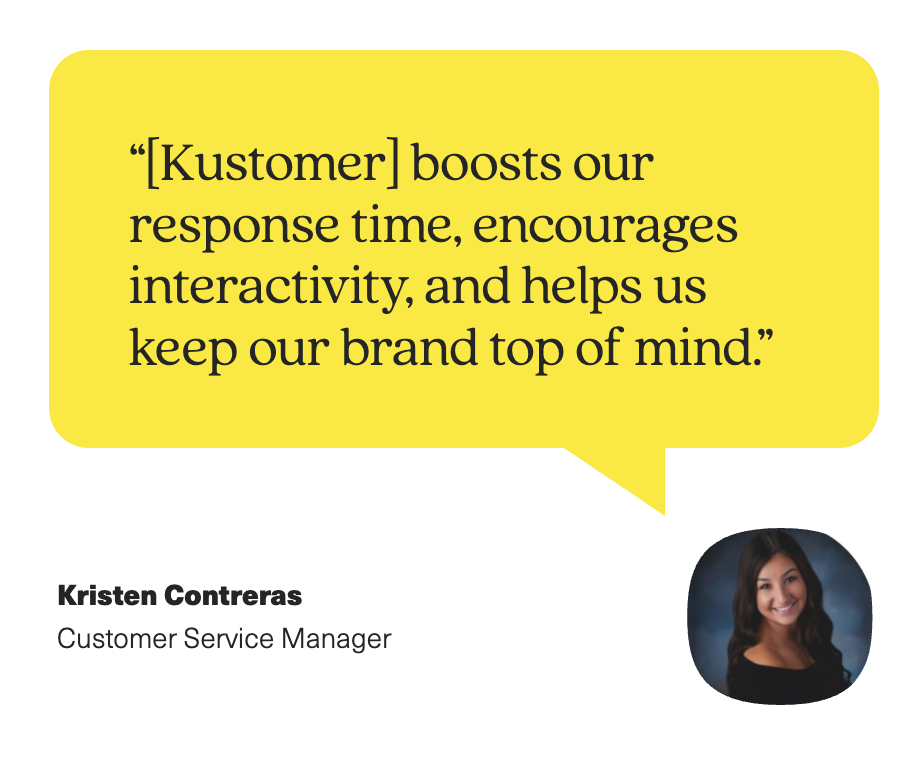
Mariano Piña, VP of Operations at APLAZO, highlighted the importance of a seamless human-handoff: "Kustomer unified our workflows in a way that removed friction from handoffs. In scenarios where conversations need to be escalated, agents receive complete context instantly, which improves speed, accuracy, and the overall customer experience."
Logistics and Field Services
Companies use AI agents via SMS and chat to provide real-time location tracking, automated quoting, and dynamic scheduling adjustments without forcing customers to call a dispatch center.
LoadUp used Kustomer AI to automate their quoting process and manage end-to-end SMS sales conversations, delivering instant accuracy that scaled revenue and increased CSAT without requiring additional headcount.
B2B SaaS Onboarding
Software companies turn complex technical documentation into AI assistants that guide new users through setup processes, troubleshoot technical errors, and automatically route high-tier bugs directly to the engineering queue.
Related reading → 12 Real-World Applications of AI in Customer Support
Top AI Ticket Resolution Solutions for 2026
The market is flooded with tools claiming to have AI, but very few actually execute automated resolutions. Here are the top platforms that move beyond basic deflection, categorized by their primary strengths.
1. Kustomer
Kustomer is a CRM-first support platform engineered specifically to resolve customer issues, not just organize them. By tying every customer interaction, transaction, and behavioral data point into a single unified timeline, Kustomer gives its AI the exact context it needs to take action. It is the premier choice for modern CX teams that want to automate complex workflows without disrupting the customer journey.
Key features
- Unified data foundation: It aggregates all omnichannel conversations and backend data into one source of truth, ensuring the AI never asks a customer for information you already have.
- Conversational AI and intelligent orchestration: It uses real-time intent detection to adapt to the customer's context rather than forcing them through rigid scripts, automatically routing complex issues to the exact right resource.
- Contextual guidance for reps: Agents see the full picture instantly with proactive signals and real-time AI assistance embedded directly into their workspace.
- Trust and compliance built-in: It provides transparent, explainable AI decisions with built-in oversight and human-in-the-loop controls so you always remain in charge of your brand experience.
- Actionable insights for leaders: It automatically turns massive volumes of conversation data into meaningful business intelligence so you can continuously optimize your support operations.
Why Kustomer stands out
- It eliminates the siloed ticket: Unlike legacy platforms that treat issues in a vacuum, Kustomer's continuous CRM architecture means the AI actually understands the customer's history and physically alters their account to resolve the problem.
- It deploys with zero code: Support leaders can design, test, and evolve complex AI orchestration journeys from day one using a guided, visual interface without needing a developer team.
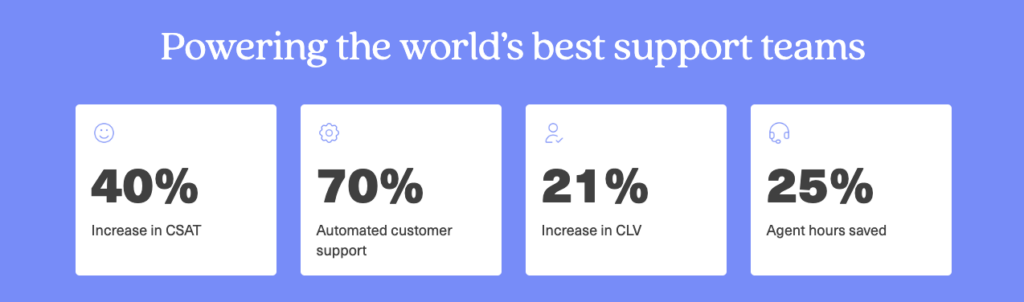
- It delivers proven, massive ROI: Based on data from over 500 G2 reviews and happy customers, Kustomer drives an 80% improvement in first response times, a 15-point increase in CSAT scores, a 25% reduction in agent hours, and a 40% decrease in the total cost per contact.

2. ServiceNow (ITSM Pro Plus)
ServiceNow is the undeniable heavyweight for internal IT Service Management (ITSM). It is built to handle the massive, complex IT support operations of global enterprises. Its AI capabilities focus heavily on workflow orchestration, incident clustering, and predicting system outages before they happen.
Key features
- Now assist: It uses generative AI systems to provide summaries of massive incident logs and generate clear resolution notes for IT technicians.
- Agentic workflows: It orchestrates complex, cross-departmental tasks like employee onboarding across HR, IT, and security.
- Predictive intelligence: It automatically categorizes, routes, and prioritizes high-volume IT alerts to the correct engineering queue.
Pros
- Offers unparalleled power for enterprise IT operations and compliance.
- Deep platform-native AI handles highly complex workflow automation.
Cons
- Extremely expensive and requires dedicated developers to implement.
- Built primarily for internal IT, making it clunky for B2C customer service.
3. Zendesk
Zendesk is the legacy giant of the customer service space. It provides a massive, highly customizable backend that large enterprises use to build complex, multi-brand support operations. Its AI features focus heavily on routing precision and agent productivity.
Key features
- Advanced intent detection: It analyzes incoming messages to identify customer sentiment and route the ticket to the most appropriate specialized agent.
- Macro suggestions: It scans historical ticket data to recommend new automated responses and macros for your customer support team to build.
- Custom bot builder: It provides a canvas to design specific conversational flows across web, mobile, and social messaging channels.
Pros
- Features a massive marketplace of third-party integrations.
- Highly flexible for organizations that need complex, custom-coded routing rules.
Cons
- Advanced AI capabilities require expensive, high-tier add-on packages.
- The backend has a notoriously steep learning curve for new administrators.
Learn more → Is Zendesk Worth It? Hmm... See The Pros & Cons
4. Freshdesk (Freddy AI)
Freshdesk prioritizes speed and accessibility. It is a streamlined, user-friendly platform designed for mid-market teams that need to deploy AI quickly without a heavy technical lift. Its Freddy AI engine integrates smoothly across both its customer service and IT products.
Key features
- Freddy self-service: It deploys conversational bots that ingest your knowledge base to deliver instant, natural-language answers to routine queries.
- Ticket summarization: It provides human agents with a concise brief on long, convoluted email threads the moment they open the support ticket.
- Automated triage: It uses historical routing data to instantly categorize and assign incoming tickets based on agent workload and skill.
Pros
- Highly intuitive interface guarantees rapid deployment and easy agent onboarding.
- Offers excellent time-to-value with predictable, bundled AI pricing.
Cons
- Lacks the deep customization and IT operations management (ITOM) features of enterprise giants.
- Advanced reporting can feel limited for highly complex support organizations.
Related reading → 17 Best Freshdesk Alternatives for 2026 (Based on Real Users)
5. Moveworks
Moveworks is an AI Copilot built exclusively for internal employee support. Instead of forcing employees to log into a clunky IT portal, it integrates directly into the enterprise messaging tools your team already uses, like Slack and Microsoft Teams.
Key features
- In-chat issue resolution: It solves routine IT, HR, and finance issues directly within Slack or Teams without ever creating a visible support ticket.
- Enterprise search: It crawls fragmented company wikis, Google Drive, and SharePoint to instantly surface the right internal document.
- Multilingual translation: It seamlessly translates internal support requests and company announcements across global teams in real time.
Pros
- Creates a completely frictionless, invisible support experience for employees.
- Features highly sophisticated natural language processing for complex internal queries.
Cons
- Built strictly for internal employee support; cannot be used for external customers.
- Full functionality often requires purchasing multiple add-on modules.
6. Intercom
Intercom revolutionized chat-first support and remains the premier choice for B2B SaaS and digital-native brands. Its standout feature is Fin, an incredibly autonomous AI agent that requires virtually zero manual training to start resolving complex technical questions.
Key features
- Fin AI agent: It ingests your help center and immediately begins resolving customer questions in natural language with exceptionally high accuracy.
- Proactive messaging: It identifies when a user is stuck in your software and triggers a helpful AI intervention before they even submit a ticket.
- Visual workflow builder: It allows support leaders to map out conditional routing logic and data capture flows without writing any code.
Pros
- Fin provides industry-leading conversational accuracy right out of the box.
- The sleek, in-app widget is perfect for modern tech companies.
Cons
- It is one of the most expensive platforms available, heavily relying on per-resolution pricing.
- The interface is less optimized for traditional, long-form email ticketing.
Learn more → 20 Best Intercom Alternatives & Competitors for 2026
Automate Your Ticket Resolution with Kustomer
AI is only as powerful as the data it can access. If your support platform forces your AI to operate in a silo, you aren't resolving tickets—you are just building a fancier deflection wall.
Kustomer layers powerful intelligence onto a unified CRM foundation, delivering smarter automation without the disruption. By reasoning through complex workflows and tapping directly into your customer history, Kustomer AI drives outcomes from day one. You get the operational scale of an autonomous service desk while maintaining the oversight and human-in-the-loop compliance required to protect your brand.
The results are immediate: happier customers, more confident reps, and radically lower support costs.
Take Aplazo, a leading Buy Now, Pay Later platform. By deploying Kustomer AI as an intelligent frontline shield across WhatsApp and in-app chat, they fully automated routine queries and created frictionless handoffs to human agents. This instantly reduced agent overwhelm and drove a 40% increase in customer satisfaction (CSAT) in just four months.
Eliminate your ticket backlog and free up your agents today. Try Kustomer AI free for 30 days to see how intelligent CX can transform your business.
FAQs
What is the difference between an AI chatbot and an AI agent?
A traditional chatbot relies on rigid scripts and decision trees, usually just surfacing links to help center articles. An AI agent leverages natural language processing and generative AI to actually understand user intent. It can access backend systems via APIs to autonomously execute multi-step workflows, like processing a refund or upgrading a subscription, without any human input.
Will AI ticketing replace human support agents?
No. AI replaces repetitive manual tasks, not people. By handling Tier 0 and Tier 1 routine inquiries (like order tracking and password resets), AI frees up your human agents to handle complex, emotionally sensitive, or high-value escalations that require empathy, critical thinking, and advanced troubleshooting.
How accurate is AI ticket routing?
When properly implemented, AI routing is exceptionally accurate. Modern systems use machine learning to analyze the sentiment, urgency, and context of a message, matching it against historical ticket data to find the right department. Furthermore, by using Retrieval-Augmented Generation (RAG), the AI restricts its knowledge exclusively to your verified internal documentation, nearly eliminating the risk of AI hallucinations.
Can AI help my support team meet strict SLAs?
Yes. By instantly evaluating the urgency and tone of a customer's message using sentiment analysis, the AI automatically prioritizes high-risk escalations to prevent SLA breaches. Furthermore, because routine inquiries are handled instantly by bots, your entire queue moves quicker, leading to much faster resolutions. Support leaders can track these exact improvements and monitor compliance in real-time through a centralized analytics dashboard.