
Customer experience professionals face a familiar challenge: technology stacks evolve constantly. New commerce platforms roll out. Knowledge systems get overhauled. Teams adopt new collaboration tools. And somehow, workflows need to adapt to all of it.
The challenge with AI in customer service today is clear: we've developed sophisticated AI that can communicate with customers effectively, but we're still struggling to make AI that can actually resolve their issues. Most AI agents are constrained by limited system access, requiring human handoffs to complete even basic tasks.
The real bottleneck isn't AI capability anymore, it's connectivity. To move from chatbots to action oriented AI, we need a new way to bridge the gap between conversation and resolution.
Why Custom AI Integrations Fail in Customer Service
Consider a typical scenario: your AI can craft thoughtful, empathetic responses to customer inquiries, but when someone asks "Where's my order?" it can't actually check your commerce platform. When a customer wants to update their subscription, the AI must hand things off to a human agent who then accesses multiple systems to complete the task.
This is a common experience. Organizations launch AI initiatives with high expectations, only to discover that without access to operational systems, their AI functions as an expensive chatbot that generates polished "let me transfer you to someone who can help" messages.
Most companies address this by building custom integrations for each new system, a time-consuming process that creates fragile connections that require maintenance with every system update. This approach creates technical debt and limits scalability.
The End of Custom Integration Madness
The Model Context Protocol (MCP) addresses this challenge by creating a standardized approach for AI systems to connect to external platforms. Instead of building custom bridges between your AI and every platform you use, MCP establishes a consistent connectivity layer.
What is MCP? Think of MCP as a universal standard for AI connectivity. Just as USB allows any compatible device to connect using the same approach, MCP enables AI agents to connect to any MCP-enabled platform using standardized methods. This eliminates the need for custom integrations with every new tool added to your stack.
Kustomer implements this through:
- MCP Client: Connects Kustomer AI agents to external MCP-compliant systems
- MCP Server: Exposes Kustomer's capabilities to other AI platforms
This bidirectional approach means your AI can both pull information from other systems and allow other platforms to access Kustomer's data and actions.
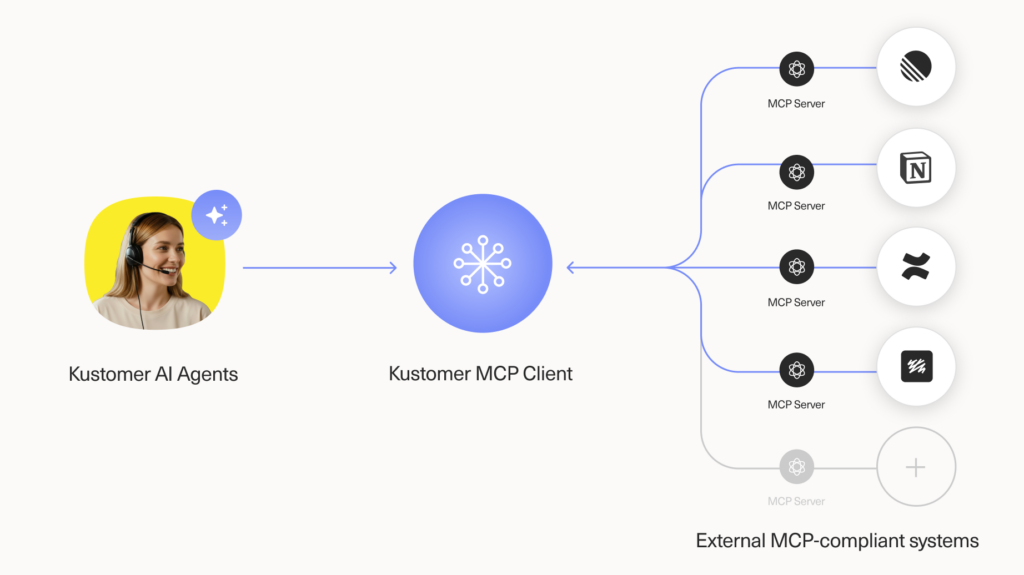
MCP compatibility already exists with established platforms like Notion, Confluence, Sanity, Jira and Linear, which means your AI agents can immediately tap into your knowledge bases, project management tools, and content management systems without custom development work.
When new platforms become MCP-compatible, your AI agents can connect using the same approach that already works with these existing integrations. This provides the flexibility needed to keep pace with evolving CX technology requirements.evolving CX technology requirements.
Operational Impact
While protocols and connectivity might sound technical, the operational benefits are significant. When AI agents can access and act across systems, they transition from basic response generators to active problem solvers.
Resolution times improve because there's less back-and-forth between systems. Representatives spend less time switching between applications and manually transferring information. When you want to add new tools to your stack, you don't need to wait for engineering resources to build custom integrations.
The ecosystem expands naturally as more platforms adopt MCP compatibility, allowing AI agents to extend into new systems without requiring changes to your automation strategy.
How This Works in Practice
Consider this common customer service scenario:
Customer asks: "Where is my order?"
Without MCP: AI generates a response like "Let me connect you with someone who can look that up for you." The customer waits while an agent logs into the commerce system, locates the order, checks shipping status, and reports back.
With MCP: AI retrieves real-time order data directly from your commerce system, identifies that the package is delayed due to weather, and responds immediately with accurate information. If the customer needs additional context, the AI can also pull relevant documentation from your Notion knowledge base or check Linear for any related known issues. If the customer wants to change the delivery address, the AI can execute that change directly within the conversation.
The difference between a standard chatbot and an MCP-enabled AI agent is the difference between a gatekeeper and a problem solver.
| Feature | Traditional AI (No MCP) | Future-Proof AI (With MCP) |
| Response Style | Generic and conversational. | Data-driven and actionable. |
| System Access | Isolated; cannot "see" your commerce tools. | Universal; pulls real-time data from any platform. |
| Human Effort | High; requires manual agent handoff. | Low; AI resolves the issue autonomously. |
| Customer Experience | Frustrating "I'll find someone to help" loop. | Quick resolution with accurate context. |
The customer receives immediate, accurate information. The issue progresses without escalation. Support teams can focus on complex problems that require human judgment and expertise.
Enterprise-Grade Governance
System connectivity expansion requires both flexibility and control. Organizations need assurance that AI access remains secure and aligned with business policies.
Kustomer's MCP implementation includes enterprise-grade authentication, secure session management, and configurable controls. Teams determine which tools AI agents can access, what actions they're authorized to perform, and how they connect to external systems. Workflows can be tested before deployment, and access can be restricted at granular levels.
This approach provides intelligent automation that operates within established company rules and procedures.
This capability works whether you're using Kustomer as your primary helpdesk or layering Kustomer AI on top of other platforms like Zendesk. MCP creates connectivity regardless of your underlying infrastructure.
Strategic Transformation
What's most compelling about this approach is the shift from AI that simply responds to customers toward AI that coordinates work across your entire CX ecosystem. When new tools are introduced, your AI can adapt. When workflows change, automation adjusts accordingly.
This isn't just about faster customer service. It's about building a foundation that evolves with your business rather than constraining it.
As organizations scale, AI scales with them, moving CX teams away from fragmented integrations toward a connected, intelligent platform designed for continuous evolution.
Ready to Get Started?
AI effectiveness shouldn't depend on your team's integration capacity. With MCP, AI agents expand alongside your technology stack. As new MCP-enabled platforms emerge, whether they're commerce tools, knowledge bases, or internal systems, they can connect without initiating new development cycles.
Existing integrations remain functional while new capabilities can be added as needed. Your AI infrastructure grows with your business requirements.
If you're already using Kustomer, reach out to your CSM to learn more about enabling MCP connectivity. If you're evaluating different platforms, consider how a connected AI ecosystem could transform isolated customer interactions into coordinated resolutions across your entire stack, book a demo to see it in action. And if you're currently using another helpdesk like Zendesk but want to add AI capabilities, Kustomer AI can layer on top of your existing setup while still providing all these MCP connectivity benefits.
Ultimately, customers don't care about your internal systems. They want their problems solved quickly and completely. MCP helps make that happen by connecting AI to the tools and data needed for comprehensive resolution.