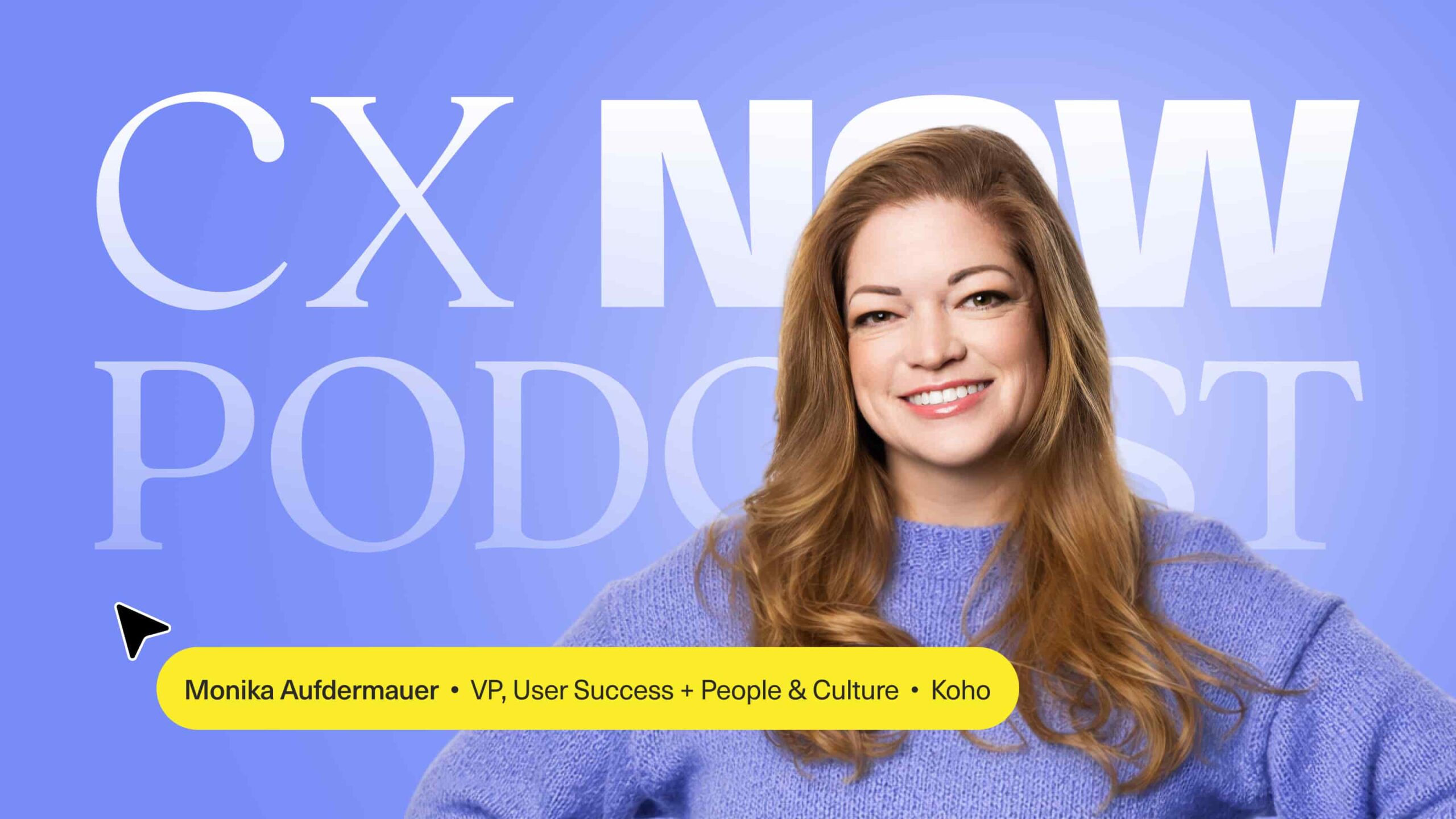
In this episode of CX Now, host Lauren Gold sits down with Monika Aufermauer, VP of User Success and People and Culture at Koho. Monika holds a rare dual mandate — overseeing both the customer experience and the people and culture functions — and has made it her mission to explore what happens when you stop treating the two as separate disciplines.
This interview has been lightly edited for clarity.
Lauren Gold: Monika, would love to hear a little bit more about your story and how you came into this — I would say dual role, but I'm sure it's a multiple, multiple role scenario.
Monika Aufdermauer: I would say that I fell into this role quite how I fell into user experience close to 25 years ago. We were at an executive offsite discussing our hiring strategy for the coming year — this was a couple of years ago, going into 2025. One of the roles we had on the list was to hire a VP of People, and as we were discussing it — you know, always a startup company, thinking about how we can save money — I kept thinking about that role and said, "Hey, can I do that?" Our CEO said, "Sure, done," and we kind of moved on. It wasn't until a little bit later that it really sunk in what I had just committed myself to. But it has been absolutely amazing and really, really rewarding. I've been doing CX for so many years, so it's been fun to be learning again in a really major way and having a lot of fun with what we can do — and also taking what I do supporting customers and translating that into supporting employees. Because it really is two sides of the same coin. It's all support.
Lauren Gold: That makes a lot of sense when you say it that way. When you took on a People and Culture function on top of the CX role, I think most leaders would brace for impact — brace to be super overwhelmed — but you kind of found the opposite. What was it about holding both roles simultaneously that actually created clarity rather than chaos?
Monika Aufdermauer: I won't say there's been no chaos — there definitely has been some, especially when I signed myself up to launch new software on both sides at the exact same time. But what I found walking into the People role was to really just approach it in the exact same way I've approached everything in support and flip things around to look at it through that lens. As we've transitioned, it has become much less of a reactive place to be. We are much more of a proactive team. We're not quite all the way there yet, but it has definitely shifted drastically in the last 18 months, with huge plans to continue that shift this year. By looking at it from a lens I know really well and have used for 25 years, it took the overwhelm out of it. It was like, "All right, let's just go in and support the people that work here." And as I walked our People and Culture team through how I was thinking about this, they really leaned into this support model.
Lauren Gold: I love that. Was your aha moment before you took on the role — it sounds like you suggested it — or after? Was there a specific moment, maybe a data point, a conversation, a burned-out agent, a frustrated customer, something that first made you draw that parallel? Like, wow, employee experience and customer experience are actually quite similar — it's a similar problem we're trying to solve.
Monika Aufdermauer: My approach in the CX world has for many, many years always been to be more proactive and to support the people on the other end. From leaning into AI really early and making sure we're getting really good analytics out of CX to proactively solve problems — as I looked at the People and Culture function, this was kind of what prompted me to raise my hand. I was like, "I really don't think this is drastically different than what I'm doing today." It's all about people and humans. At the end of the day, all humans want to feel validated and feel like they're getting the best support they can — whether that's someone who's paying us or someone we're paying.
Lauren Gold: That makes a lot of sense. So let's talk about your onboarding philosophy. A lot of companies treat onboarding as an orientation checklist — you're in and you're out. You rebuilt yours around a different idea entirely. What does setting someone up to do their best work from day one actually mean in practice?
Monika Aufdermauer: I would be remiss not to call out our amazing coaching team who runs our onboarding. Kat, in my org, was definitely the face of driving change here. As we sat down to figure out what it means to start at Koho — especially in a remote world — it's about how we can get someone all of the context they need to set them up for success and become impactful on day one. That was how we really took in and revised everything we were doing in onboarding. We have context-gathering sessions. We've taken all of the different parts of the organization and turned them into bite-sized sessions, so people have a mix of both async and synchronous work in their first two weeks. We also found that by really planning out people's first two weeks — in conjunction with their managers, setting up first manager touch points and identifying who they need to meet — we were creating repeatability and making sure that everyone's experience was the same.
We've really driven our onboarding satisfaction up. Our last numbers were about 4.5 to 4.6, and we started below four. It has been an amazing change. We've had engineers shipping code within their first two weeks, which is not what we were seeing before. We also had a product manager the other day ship their first bit of code — because of all of the enablement we've done on both the People and Culture side and as a company in AI.
Lauren Gold: Wow, that's amazing. Even for agents or any employee at Koho — what an experience to know that AI goes beyond their day job and is actually part of that onboarding. That's really investing in people's careers.
Monika Aufdermauer: Yes. And we've taken that further — right now we have our first session of our Leadership Labs, where we've identified leaders early in their careers and are really setting them up to be the best leaders they can be. Our philosophy there is much like with users: if you give them all of the right tools, they're going to turn around and make you more money. With our employees, if we can give them all of the right tools to be better leaders, they're going to create better teams within their organizations. And if I look at that from a very direct standpoint — and what will always be my heart is the CX part of this — if I have people within the organization operating better and putting out better work in service of our users, we inadvertently create a better user experience.
Lauren Gold: Your years inside of CX — watching agents struggle to onboard, seeing who lasted and who didn't — so much of your earlier experience directly shaped how you approached building your team from the ground up. Can you share some concrete examples or insights from the CX side that changed how you hired or structured your people?
Monika Aufdermauer: Support is such a unique role to hire for. You tend to get folks that are early in their careers and don't have a whole lot of job experience, but then on the other side, you also get people at the later end of their careers looking for something to carry them through. Finding the right balance in how you support people at all different parts of that journey was an interesting piece. So we had to make sure our onboarding in CX was set up in a way that supported every person's learning abilities and learning styles. We made sure we were looking at videos paired with the ability to read and live sessions where people are going through hands-on experience. We developed the CX onboarding journey before people actually start supporting customers — all in service of those different learning styles — so that everyone gets what they need by the time they reach the end of that journey. They're ready to go. And we've been able to shorten our onboarding time from about seven to eight weeks down to about three weeks.
Lauren Gold: Pair that stat with the one you shared earlier about onboarding satisfaction increasing by almost an entire point — that's incredible growth. Well done. So let's talk about what I call the leadership trap. There's a version of a CX leader and a version of a people leader that both get stuck in a reactive state. We've all been there and we understand why it happens. Even when you're in it, you know it's happening — solving symptoms instead of root causes. What are some of the early warning signs you've been able to develop, or train your team on, that signal a CX team is operating that way? What makes you say, "Hey, we have to pause and get out of reactive mode"?
Monika Aufdermauer: One good thing I can say is that at Koho, for at least the last two to three years, we have not been operating in a reactive state. The first year to 18 months I was here, everything was very reactive. But as we were able to start putting the right tools and metrics in place, we were able to really shift into proactive mode: how do we solve these problems upfront? The one thing I would always encourage CX teams to have is great data. The more you have in analytics, the easier it is to talk to product teams and get those problems solved. For us, we're always looking at what the biggest bucket of issues coming into our support org is and how we can work with product and engineering teams to get those things solved.
Since I started at Koho, we've gone from a 26% monthly contact rate — meaning every month, 26% of our customers were contacting us — down to 5.1% last month. All of that is because we don't just look at what's happening or try to get unstuck. We live in that mindset of: how are we identifying how to solve these problems? We know our teams have to live in the day-to-day, but putting in place the part of the organization that's looking at the numbers, analyzing what's happening, getting to the root cause, and taking that back to our product teams to get solved — that's where we've really thrived. The other part is definitely AI and how we can take the things that are easy and repeatable and solve those quickly. That's really in the benefit of users. If a user can get an answer in five seconds versus ten minutes, that is a better user experience. It also frees up the humans helping customers to really be there for the moments that matter — giving them the time and space to really pay attention to people, not having to rush anyone through. We've really found that in that transition, you're not chasing a number. You're not just trying to get this person in and out. You're really trying to solve their problem.
Lauren Gold: I knew this was going to be insightful, but Monika brought the metrics today. You said 26% down to 5%? That is incredible. So let's do our last question. You've been pretty clear that most companies are leaving performance on the table by treating CX and employee experience as separate functions. For a CX leader who doesn't know where to start, what's the first move they should be thinking about to align these functions and boost performance?
Monika Aufdermauer: Not everyone says this out loud, but every company should really be looking at their users — their customers — as their number one priority. Without those folks, nothing else exists. You don't have employees, you don't have any of it. The more you put those people at the forefront of everything you do, the better results you get. At Koho, one of our values is "user first." That's been the lens I've tried to apply to everything we're doing — whether that's how our employees operate or how our CX team operates, we're all trying to make sure our users are getting the best service they possibly can. Because that's how you make money. That's what every company is trying to do. The more you can take that mentality of customer and user first across all parts of the organization, the easier it is to align the experience for everyone.
Lauren Gold: Thank you so much, Monika. We're so lucky you were here today. You are absolutely a CX leader to watch. You raised the bar for all of us, and I'm always personally grateful for the time we get to spend together — you always leave me with great insights and things to think about. A definite innovator and trailblazer.
Monika Aufdermauer: Thank you so much for having me.
Subscribe
Missed the last episode? Catch up! Tune in to Kustomer's AI Vision with CEO Brad Birnbaum.
We’ll be dropping episodes every other Friday. Subscribe wherever you get your podcasts: