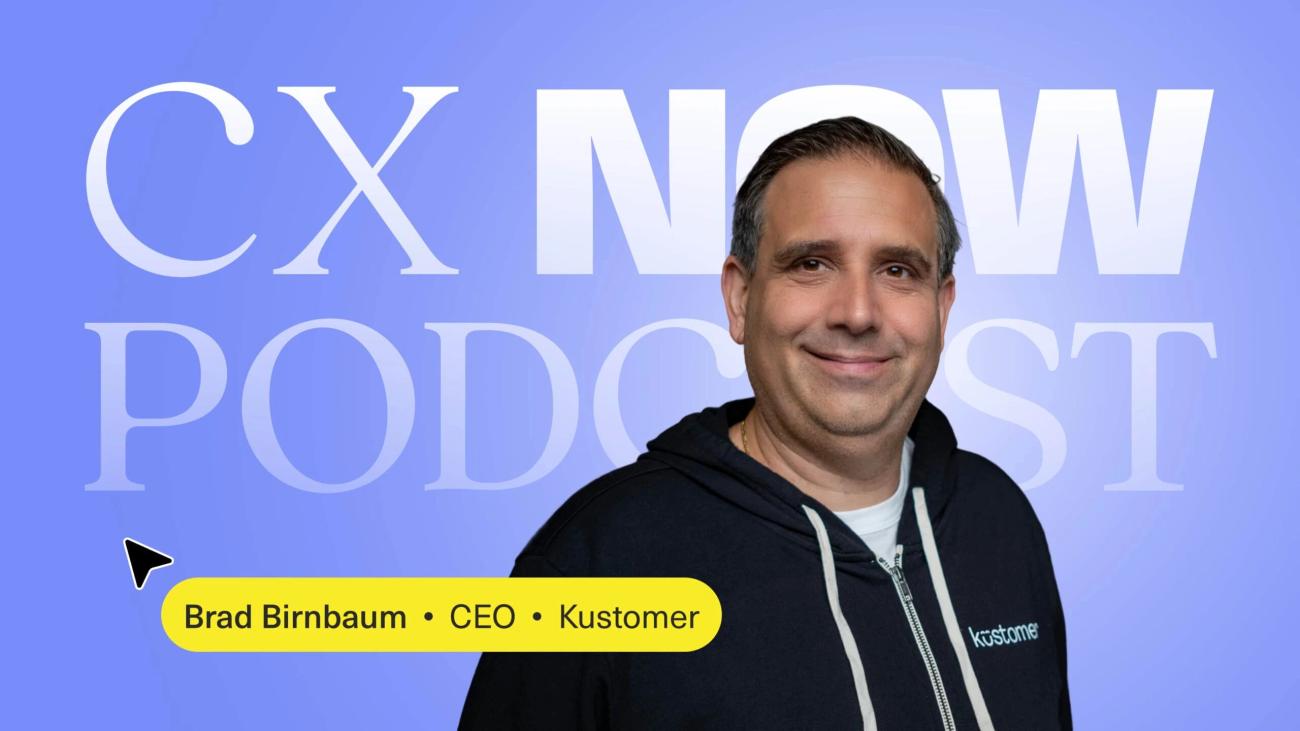
Kustomer's AI Vision with CEO Brad Birnbaum
Listen to the episode
Watch the Live Recording
You may be wondering — why launch another podcast? We had such a great experience with our CX Now events in New York and LA last year. We had amazing sessions with thought leaders, operators, and researchers in customer experience, and we wanted to bring that same energy to you all year round, wherever you are — not just for those who could attend our in-person events.
CX Now will dig into topics surrounding CX, AI, data, and best practices, and you'll walk away with actionable insights every time.
While our podcast will generally focus on broader CX industry themes, it felt appropriate to kick off our first session with Kustomer CEO Brad Birnbaum sharing Kustomer's AI vision. His career has centered around creating tools that change the way CX leaders and frontline agents do their work to deliver superior customer experiences.
This interview has been lightly edited for clarity.
Lauren Gold: Let's dive right in around the founding belief. Kustomer was founded 10 years ago with the vision to change how businesses support and engage with their customers. How has AI changed what that vision actually looks like in practice today?
Brad Birnbaum: I love that question. My personal belief — and really our corporate one — is that AI is magic. It is transformational in ways that I couldn't even dream of in the 30 years I've been building customer support software.
It's enabling us to transform the way we think about delivering amazing experiences, the way we build those experiences, and the rate at which we're able to do it. It's even transforming the way we service our own customers.
For as long as I can remember, we've all been striving to find a way to enable agents to become superhuman. We've all been looking for ways to handle simple use cases — or even borderline complex use cases — automatically, allowing us to scale infinitely, be available 24/7, and handle things like Black Friday if you're a retailer, where it's really hard to scale and predict. Businesses often face variability — weather events cause delivery exceptions, and so on. Having a tool that enables a business to handle unlimited volume with a high level of quality and certainty is magical.
One of our products, AIC (AI for Customers) is great at that. It's an agentic and hybrid deterministic engine all in one. It enables you to deliver exactly the right support mechanism for your customers. Some things require very deterministic outcomes. Others benefit from agentic AI — using true intelligence to determine the outcome and orchestrate it across all of your third-party systems. AIC has been magical for our customers. We're seeing some hitting as high as 70–75% automation rates, and it was tremendous for a lot of our retailers last Black Friday.
In addition, there are so many other ways AI can be used for customer support. Another area we're very focused on is supercharging the humans. We don't believe in a world of zero humans anytime soon. AI can certainly assist and automate certain use cases, but many things will still ultimately go to humans — more complex use cases, situations that require empathy, and a variety of other scenarios depending on the type of business.
When it does go to a human, we want to supercharge that person. We want the system to do everything from suggesting next actions and responses to giving agents a co-pilot they can actually talk to about the issue they're trying to resolve. And then we want to give agents something that can understand everything about their customer — we call that Signals. It looks across all communications and interactions you've had with customers, as well as all the object data you might have — order information, return information — and starts to find patterns. This customer is a frequent returner. This customer always buys a size medium shirt, but the data shows he actually needs a large. He's bought so many mediums and keeps exchanging them. Maybe we can help guide through that.
There's also what I call micro AI — these little moments of delight you don't even realize. Something as simple as a date picker: instead of scrolling to find a date, you just type "200 days from now" and it handles it. Or in the reply editor, as an agent is typing, AI is completing the response for them. So many ways to help.
And that's just from the customer and agent perspective. From the system manager's perspective, it goes even further. We have at least 20 assistants built to help everything from setting up our platform to using AI to help create the AI — a bit like Inception. These assistants help configure and build prompts and procedures, so you're not having to think through the mechanics. You just tell it how you want your business to run and it figures out how to make sure your procedures are handling both the deterministic and agentic sides correctly.
And then there's the leader side. Historically, understanding how your business is running meant going into reports, configuring fields, grouping, pivoting, setting date ranges. We now have Data Explorer — probably one of the most beloved features we've released in quite a while. Think of it as ChatGPT on top of your data for supervisors who are responsible for analyzing the performance of their business and teams. You can ask it anything.
I often challenge our customers to use their imagination, because they're not being creative enough. They'll write a prompt like "show me a report of how my teams have done over the last 90 days," and it does really cool things — nice visualizations, lots of graphs — in really creative and helpful ways. It has access to your conversation data, your object and order data, and we use some of the most powerful frontier models in the world to process it. I can't stress enough how much we've transformed our product offering to be AI-first.
I'm super excited about what we have in store that you don't even know about yet.
Lauren Gold: It's all really exciting. As you were talking, I kept coming back to a theme running through all of those experiences — for customers, for leaders, for reps, and for admins. You kept coming back to data. You and I have the privilege of being out in market with our customers all the time, and what we often hear is around the AI and context thesis. You've shared in the past that AI alone doesn't necessarily change CX, but AI plus context does. Can you unpack that a little more? What does context actually look like, and why does it matter so much?
Brad Birnbaum: Absolutely. The AI models we're all using are incredible. They're coming out rapidly and getting better with each iteration — something I've really never seen before as a technology person. When a new iteration comes out, it's faster, it gives better results, and it's actually cheaper to run. Faster, better, cheaper — you can't beat that. And that's going to continue.
We all have access to these models, and they're getting better and better. But they're all trained on the same data and understand the same things. Where we can help — with context in ways others aren't able to — is by giving the models the information that actually matters for servicing a specific customer. We can understand their history. Using a retail example, we can understand the products they've purchased over time, that they only shop during the holiday season, and make decisions around that. We can do a lot of interesting things with data. It's your data — we never share it — but AI can take it, interpret it, understand it at volume, pattern match, figure out how to help, and even help determine when to be empathetic.
Context is what's going to enable you to deliver amazing experiences. It's what's going to make it not feel like a robot. Whether it's through our information engines, our conversational system engines, or humans using AI to help craft responses — context is what makes it feel real, not like a knowledge base, not like a bot.
Lauren Gold: That's super helpful. Something else we hear often is around the control factor. CX leaders get concerned — am I going to lose control? I've spent all this time building an amazing customer experience, building a brand voice, and what if AI hurts that? How does Kustomer think about the balance between AI autonomy and human oversight?
Brad Birnbaum: We have a lot of tooling for that, and I'd hope anyone in the AI space is thinking this way, because it's critically important. There are a variety of things inside our agentic platform to protect you and make sure we're always providing the right experiences and responses.
The first concept is guardrails — very, very important. You need to make sure AI stays in its swim lane. Some of us have seen that infamous Chipotle bot where you could ask it anything and it would just do it. That's an example of not having proper guardrails — and that was not our software, for the record. We do love Chipotle. But that can happen without proper guardrails. You want guardrails to make sure the system knows how you want to communicate — your voice, your brand, who your competitors are, what you do — so it doesn't go off the rails. Guardrails are something we take very seriously at Kustomer.
The second is making sure your prompts are doing the right thing. There's a concept in AI called evals, or evaluations. Because AI is non-deterministic — meaning it can theoretically give you slightly different answers each time — evals are really important. As we build procedures inside our product, you need the right tooling to ensure they work consistently. Evals run scenarios against the AI hundreds or thousands of times and tell you whether you need to tune your procedures to get the desired result every time. Anyone who isn't doing that, I'd probably look elsewhere — because you have no way to know you're delivering responses with the consistency your customers expect. That means the right answers, in your voice and tone, with proper guardrails, every time. We've invested heavily in tooling for this, and we have a lot more coming.
Guardrails and evals are just a couple of the things you'll want to implement for proper AI governance.
Lauren Gold: Super helpful. And we talk a lot at Kustomer about human-in-the-loop and how powerful it can be to have that intersection between humans and AI — including handing conversations back and forth with customers.
Brad Birnbaum: Absolutely. It's one of the more unique things we get to do because we are a full platform — an amazing agentic platform alongside an enterprise-grade CRM. Here's a great retail example. Say a customer purchased a shirt, and the return policy is 30 days. Customer Brad comes in 90 days later trying to do a return. Our system would look up the order, see it's past 30 days, and say so. But let's say the customer persists, or there's a setting indicating Brad is a high-value customer with extenuating circumstances.
It gets routed to a human. The chat session moves from the AI agent to a human, who sees everything the AI agent did — the full conversation. That human might look at it and decide to approve the return exception. They simply say "approve the return exemption" and transfer it back to the AI agent to complete. The AI agent then works with the customer to wrap everything up — process the return, arrange the exchange, get the RMA number — because the human made the decision that needed to be made, and the AI can handle the rest.
AI agent to human, back to AI agent. Not a lot of products do that, and we think it's incredibly powerful in the real world. There are absolutely instances where AI agents and humans need to work together.
Lauren Gold: Amazing. And I think we can all relate as consumers to what it feels like in a situation like that — when a brand proactively recognizes your context and history, acknowledges your loyalty, and makes things right. As opposed to the flip side, where you're restating your problem for the sixth time.
So, we've seen retail customers here at Kustomer achieve AI autonomously handling up to 70% of chat conversations during peak periods. What did it take to get there? How fast did they achieve it? How much tuning was required?
Brad Birnbaum: It depends. It depends on the complexity of the business, the procedures we need to create, and the use cases involved. Some businesses have very simple, common request types. Others are more complex. And it depends on what integrations are required.
If it's just looking up policies, that's very quick — we can do that through something called RAG with agentic on top and get you there fast. If you want the AI to take actions and talk to your order management system, your returns system, or your recommendation engine, that can be more complex depending on the system.
We speak MCP — model context protocol. We're both an MCP server and an MCP client, which means our agentic platform can talk to anything that speaks MCP. For those unfamiliar, MCP is effectively a standard for how AI can communicate with other APIs in a very simple way. Think of it as modern-day apps for AI — you publish an MCP server, and any MCP client can consume it. Talking to MCP servers is quick. Talking to traditional APIs takes a little longer.
So there's no single answer. It depends on what you want to accomplish, whether you want to do it in one phase or roll it out in stages, and what systems you need to talk to. I know that's not a specific answer, but there's too much variability to say precisely how long it will take without understanding a company's specifics.
Lauren Gold: Totally makes sense. Every company is at a different point in their AI transformation journey, and the right starting place varies. What do you think has more potential to disrupt the space in CX — rep-facing AI or customer-facing AI?
Brad Birnbaum: I actually think it's both, because they go hand in glove. Customer-facing AI can do some pretty magical things — we see it working well in our product and across the industry, and it will continue to get better as the frontier models improve. That said, you have to make sure you have all the right information and governance in place to make it work properly.
But on the rep-facing side — my end goal is to turn human agents from creators into reviewers. Right now, agents are handed a conversation — whether chat, email, phone, text, WhatsApp — and they're creators. They figure out what they need to do, draft a response, look things up. That's creating. What I want is for AI to have already figured all of that out, but with a level of certainty just below the threshold to hit send autonomously. The human looks at it and says "right answer, go" — or "almost, do this instead" — and the AI learns from it. That to me is the vision of where this ultimately goes, and it's absolutely something we're working toward at Kustomer.
Lauren Gold: Amazing. And maybe this is your answer here too — what are some of the biggest untapped uses for AI in customer experience?
Brad Birnbaum: We're just at the tip of the iceberg. We have some really innovative ideas on the next generation of our product that we're hard at work on right now. We're genuinely re-imagining experiences.
The first iteration of what you've seen — people figuring out how to put AI on top of their customer support — needs to be turned on its head. AI needs to be the driver of all experiences. Signals, which we recently released, is a tiny glimpse into that.
Signals is the first example of what I believe will be many UX-less parts of Kustomer. There's no prescribed user experience. AI decides what goes on your screen and how it's presented based on what's needed. But what is Signals at its core? It's our answer to truly understanding everything about a customer and giving agents the most informed, deep view possible — with zero configuration.
For a retailer, it would surface things like: Brad likes to buy salmon-colored shirts, here's his size, here's how much he's spent over the last 12 months, here's his return frequency. For a B2B SaaS business like Kustomer using our own product, Signals would surface things like: their ARR, their customer tier, their renewal date, their likelihood of churn, their recent issues, their feature requests. All of that, magically. The only configuration required is on or off.
And it's not just figuring out what you need to see — it's figuring out how you should see it. The way it groups and presents information is different for every customer. That is the future of how I think a lot of things are going to work.
Lauren Gold: So AI is moving fast — we know this. I was going to ask what it looks like 12 months from now, but can you even think that far? Twelve months feels like a decade in AI. And if we zoom out — what does it look like longer term? How does AI genuinely start to transform CX as we know it?
Brad Birnbaum: A phrase I've been using lately is: my crystal ball is broken. I cannot see the future anymore. I used to feel like I was pretty good at it, but time compression is a real thing with AI. We are building software easily 10 times faster than we were a year ago, and I think that's going to continue to accelerate.
Things we used to think of as quarterly roadmap items I now think of as monthly. It's hard to know everything we're going to get done or how things will evolve over the next 12, 24, or 36 months. But what I will say is this: you're going to see the industry — not just us, but everyone — produce product faster. The AI models are going to keep getting more powerful, including the most recent announcement from Anthropic a couple of days ago, which is almost too good — it poses a security risk in terms of finding vulnerabilities that nobody previously could. We're entering a world where these models are so powerful that people are starting to think about how to get ahead of the risks they introduce.
But the models will keep getting better. We'll figure out the right way to release more powerful models safely. And people like us who are really thinking about the best ways to use them will keep coming up with genuinely ingenious approaches. That's about the best I can offer — given my broken crystal ball — and because I'm too excited about what we're working on to share it just yet.
Lauren Gold: Everyone will have to stay tuned for that. Brad, thank you so much. I always leave conversations with you with a lot to think about. Everyone, thank you for tuning in to our first episode of CXNow. Please subscribe to stay up to date. We have an amazing lineup ahead — conversations with customers, CX leaders, people sharing their stories and perspectives. So stay tuned.
Brad Birnbaum: Thanks, everybody.
<h2>
Subscribe</h2>
We’ll be dropping episodes every other Friday. Subscribe wherever you get your podcasts: