

New AI Assistants Bring Clarity to CX Automation and AI Behavior
AI is becoming the operating system of modern CX, and at Kustomer we’re committed to making that intelligence native, woven through every workflow, every conversation, and every role in your organization.
Earlier this year, we introduced our first set of AI Assistants, built to bring smarter search, faster knowledge management, better AI agent team building and effortless workflow optimization and design directly into the platform. (If you missed it, check out the first AI Assistants launch post here.)
Today, we’re extending the Kustomer AI philosophy even further. By adding two new assistants that analyze your automations and explain your AI behavior, we’re giving every team deeper clarity, safer scale, and productivity gains across the entire CX operation.
Today, we’re excited to announce the newest members of the Kustomer AI Assistant family:
The AI automation assistant (GA) and the AI observability assistant (Early Access)
CX teams are entering a new era, one where AI isn’t just answering questions or drafting responses, but helping leaders run their operations with clarity, governance, and trust.
Together, these newest AI assistants solve two of the biggest challenges facing CX leaders today:
- Unclear, inconsistent, or outdated automations that slow teams down
- Opaque, unpredictable AI agent behavior that’s nearly impossible to debug manually
These assistants give CX organizations what they’ve been asking for:
Visibility. Governability. Confidence. And a path toward self-improving operations.
Why These Assistants Matter Right Now
Every CX org wants to scale automation and AI. But most operate on top of years of workflows, rules, brittle logic, and tribal knowledge. Two things keep CX leaders up at night:
1. “What’s actually running our customer experience?”
Quick fixes accumulate. Rules conflict. Workflows drift. Teams inherit logic they don’t fully understand. The AI automation assistant solves this by analyzing every workflow, rule, queue, and route flow and showing you exactly where conflicts, redundancies, and errors live.
2. “Why did our AI agent just do THAT?”
AI agents don’t fail like traditional software; they fail in complex, unpredictable ways.
As Forrester notes, AI failures arise “from ambiguity, miscoordination, and unpredictable dynamics”, not simple bugs. The AI observability assistant solves this by analyzing agent execution traces to explain:
- What went wrong
- Why it happened
- How to fix it
This is the difference between just deploying AI and running AI responsibly.
Meet the AI automation assistant: Your Cross-Product Automation Analyst
(Now Generally Available)
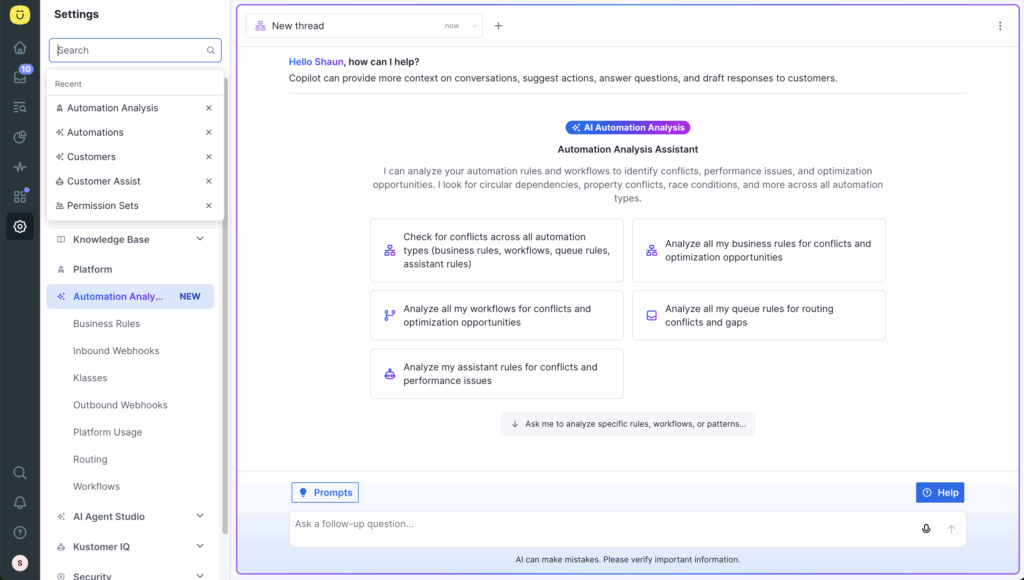
Many CX organizations hit the same wall as they scale: workflows multiply, rules stack up, queues overlap, admins change, and documentation drifts. Eventually, nobody knows what’s firing when, or why.
The AI automation assistant gives you clarity for the first time.
What it does
- Analyzes all deterministic automations across:
- Workflows
- Business rules
- Routing
- Detects conflicts, redundancies, drift, and automation bloat
- Surfaces contradictions, dead ends, and logic that will never run
- Shows exactly where issues live and how to resolve them
Why it’s different
Only Kustomer can deliver this because we’re built on a unified data model with a native orchestration engine. AI is embedded in the platform, not bolted on.
This enables true cross-product automation intelligence other CX platforms simply can’t provide.
What you get
- Cleaner logic, safer scale
- Fewer routing failures
- Hours of manual debugging replaced with instant clarity
- Faster onboarding for admins
- Increased confidence to introduce more AI safely
Meet the AI Observability Assistant: Your AI Agent Troubleshooting Partner
(Generally Available in January)
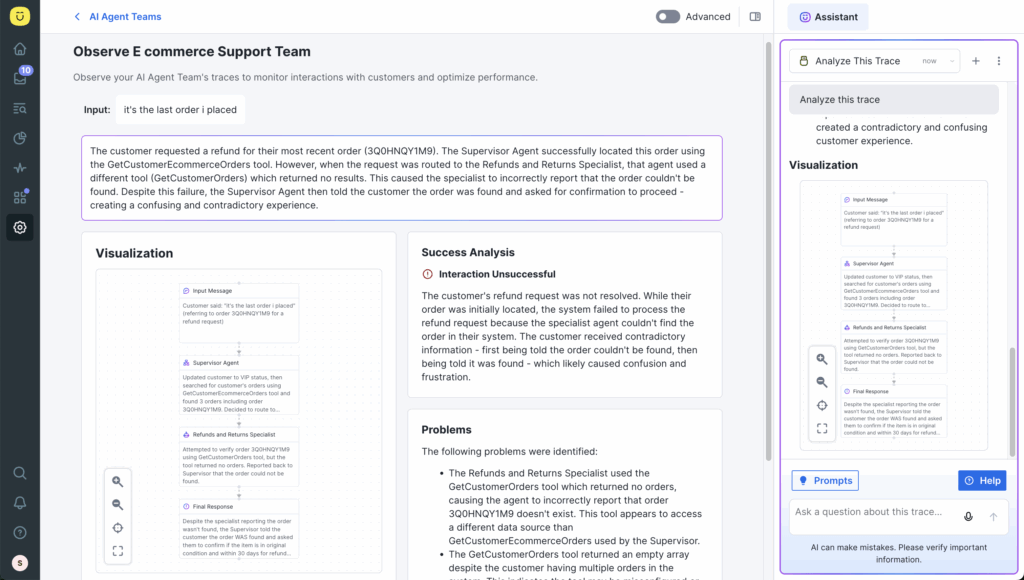
As AI takes on more responsibility, especially customer-facing interactions, the cost of a bad response or failed tool call grows exponentially.
But debugging AI is painful; admins typically sift through long, step-by-step traces just to figure out where something went wrong.
The AI observability assistant fixes this.
What it does
- Analyzes AI Agents for Customers agent execution traces
- Summarizes what happened in plain language
- Identifies root causes (bad tool calls, wrong knowledge base article, ambiguous instructions)
- Surfaces recommended next steps
Why it matters
For the first time, teams get:
- Fast, reliable AI debugging
- Better governance and safer deployments
- Higher AI accuracy and consistency
- Reduced operational risk
Built for CX leaders running AI at scale
- Improve CSAT and lower AHT
- Admins-only for safety and control
- Think of it as “x-ray vision” for how your AI behaves
Together, These Assistants Deliver the Foundation for AI-Native CX
Teams now have visibility into both sides of their operation:
1. Deterministic automation
Workflows, rules, routing, and logic → Analyzed and optimized by the AI automation assistant
2. Non-deterministic AI behavior
AI Agents for Customers with agent reasoning, decisions, tool calls → Explained and diagnosed by the AI observability assistant
This is the intelligence layer modern CX teams have been missing.
And it’s only the beginning.
Coming Soon: The Next Wave of AI Assistants
We’re building toward a fully AI-native CX platform where automation and AI improve continuously, with humans firmly in control.
Here’s what’s next: The AI setup assistant will simplify setup and configuration, reduce errors in early deployment, and get admins productive from day one.
The Path to Self-Improving CX Starts Here
The AI automation assistant and AI observability assistant give CX teams the clarity, governance, and trust they need to scale AI responsibly.
This is what AI-native customer experience looks like: A platform that’s intelligent, explainable, proactive, and built for real-world operations.


